
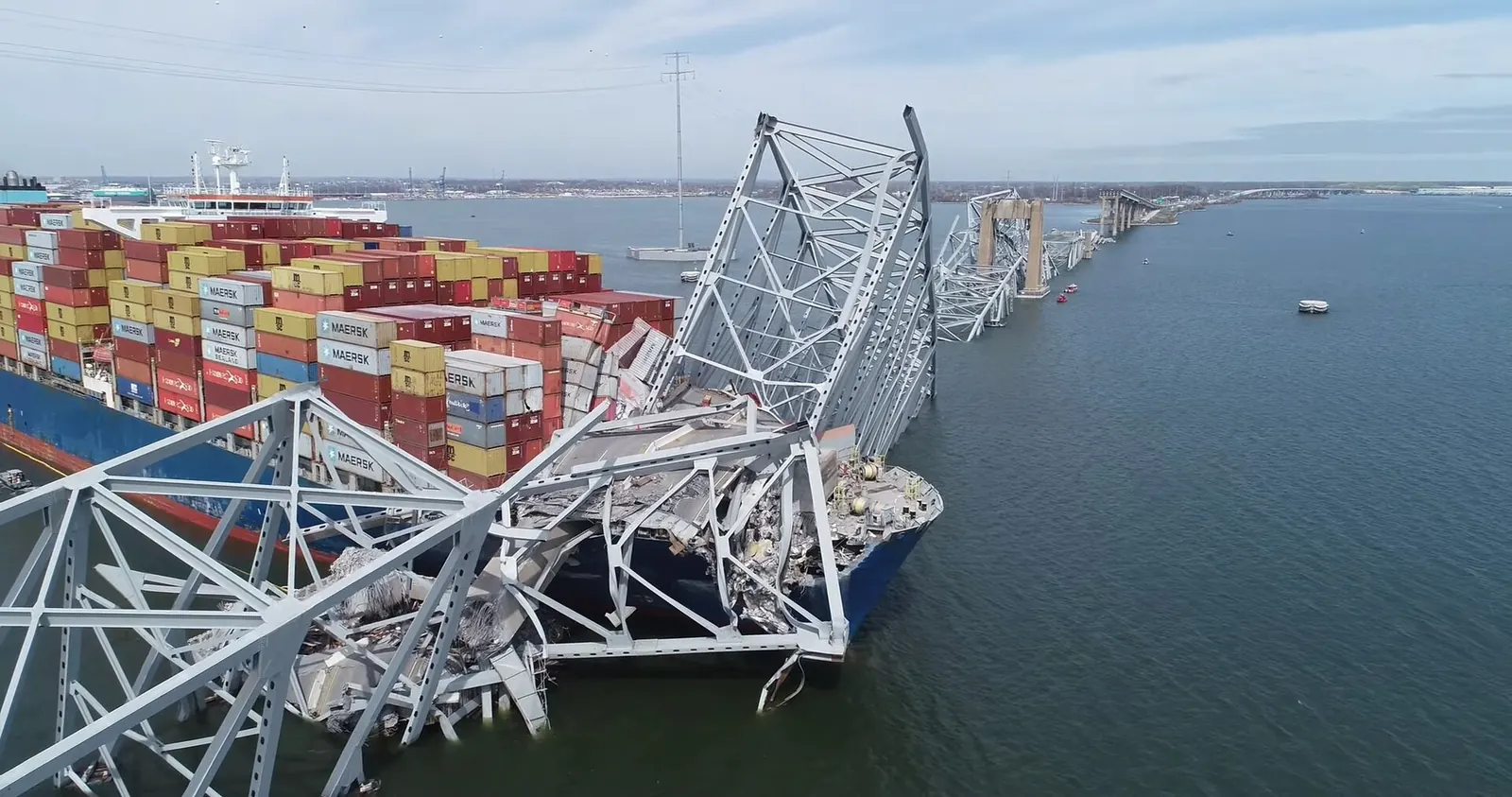
The collapse of the Francis Scott Key Bridge into the Patapsco River on March 26 closed the Port of Baltimore to shipping. The human toll was the first story. The economic one is still unfolding, and for energy markets it is mostly a coal story. Baltimore handled 28% of US coal exports in 2023, second only to Hampton Roads in Virginia. The port's two coal terminals connect the northern Appalachian coal fields to buyers in India, Europe and East Asia. For several weeks at least, that link is broken.
The episode is a reminder of something that is easy to miss in discussions of coal's decline at home. A shrinking share of US coal is burned in American power plants. A growing share leaves by sea. That makes the industry more exposed to a handful of export facilities and to the economics of buyers on the other side of the world.
What moves through Baltimore
Coal exports from Baltimore were around 20 million short tons in three of the past five years, with 2020 the exception as the pandemic cut demand worldwide. In 2023 they jumped to 28 million short tons, driven mainly by growing demand in Asia.
Most of that is steam coal, used for power generation and industrial heat. Steam coal shipments averaged about 12 million short tons a year from 2019 to 2022 before reaching 19 million short tons in 2023. India has been by far the largest buyer of Baltimore steam coal over the past five years, with its brick manufacturing industry a major customer. European buyers, reached through ports in the Netherlands, are next, with smaller volumes going to the Dominican Republic, Canada and Egypt.
Metallurgical coal, used in steelmaking, is the other important stream. Japan took 28% of Baltimore's metallurgical shipments in 2023, and China and South Korea have been the next largest buyers over five years.
Two terminals do the work: the Curtis Bay Coal Piers, served by CSX, and the CONSOL Energy Baltimore Marine Terminal, served by both CSX and Norfolk Southern. Baltimore's appeal lies in its closeness to the coal fields of western Pennsylvania and northern West Virginia.
A shrinking home market
The Energy Information Administration's latest outlook puts total US coal consumption at 482 million short tons in 2024, 29% below 2019. Exports are expected to make up 19% of total demand in 2024 and 21% in 2025. Electric power will still take most of the coal, but its share falls to 73% in 2024 and 70% in 2025, from 79% in 2019.
The absolute numbers are stark. In 2019 the power sector consumed 539 million short tons, while exports totaled 94 million. The EIA expects power sector use to fall to 352 million short tons in 2024 and 322 million in 2025. Exports, estimated at 100 million short tons in 2023, are expected to stay roughly level.
So while total demand is falling, the export channel is holding up. For mines in northern Appalachia, the export market is now one of the main reasons to keep producing.
Why concentration matters
When a domestic power plant closes, a mine loses one customer among several. When an export terminal closes, a mine can lose access to an entire market at once. The Baltimore closure exposes that concentration.
The EIA notes that other ports, notably Hampton Roads, have spare capacity to export coal, but switching is not simple. Coal quality, pricing and scheduling all affect how easily a producer can move volumes to a different terminal. Rail routes need to be rearranged. Contracts specify loading ports. Some coal blends are tied to particular facilities. Even with available dock space elsewhere, a shift takes time and adds cost.
There is also a pricing effect. Export coal is sold into a global market where buyers have alternatives in Indonesia, Australia, South Africa, Colombia and Russia. A US supplier that cannot deliver on time risks losing a customer, not just a cargo. Indian brick makers and power plants can buy elsewhere if Baltimore volumes are delayed for long.
The competitive field has also been reshaped by sanctions on Russia. Since EU sanctions took full effect in August 2022, coal imports into European countries from Russia fell 57% between the year to July 2022 and the year to July 2023, and US exports to Europe rose to help fill the gap. Russian coal has been redirected to a small group of buyers: China, South Korea, Turkiye and India took more than 80% of Russia's coal exports from August 2022 to July 2023, up from 47% a year earlier. For an American exporter selling steam coal to India, that means competing against Russian cargoes that need a home. A supply interruption at Baltimore gives those competitors an opening.
What the closure does not change
The Baltimore disruption matters most for coal and for some specialized imports. The EIA notes that refined petroleum imports into the port are limited. The largest category is biodiesel feedstock and other edible oils, about 3,000 barrels per day in 2023, mostly from Central America and Western Europe. That is small in national terms. Baltimore is not a major crude or product hub, and the closure does not threaten fuel supply to the mid-Atlantic in any serious way.
For electricity, the effect is close to zero. The coal that moves through Baltimore is not going to American power plants.
The forecast was already flat
Before the bridge fell, the EIA expected US coal exports to grow only 1% in 2024. The closure could push that into a decline, depending on how long the channel stays shut and how much volume can be diverted. A short closure might shift exports by a few weeks. A long one could mean lost contracts.
The broader point is that the US coal industry's future increasingly depends on demand outside the United States, and especially in Asia. India's growing use of coal for power and industry has been a lifeline for some American producers. That demand is real but price-sensitive, and it is served from a short list of East Coast export terminals.
A logistical fragility worth pricing
There is a lesson here beyond coal. As US energy exports grow, in LNG, crude, refined products and coal, the country is building a trade system that depends on a limited number of ports and channels. A single accident can remove a significant share of export capacity for a commodity. For LNG, that risk sits in a few Gulf Coast terminals. For coal, it sits in Baltimore and Hampton Roads.
Producers and buyers both need to plan around that. For coal miners in northern Appalachia, the practical question is how quickly rail and terminal operators can reroute volumes to Hampton Roads and what that costs. For policymakers, the question is whether export infrastructure is resilient enough for a country that now earns a growing share of its energy income from selling abroad.