
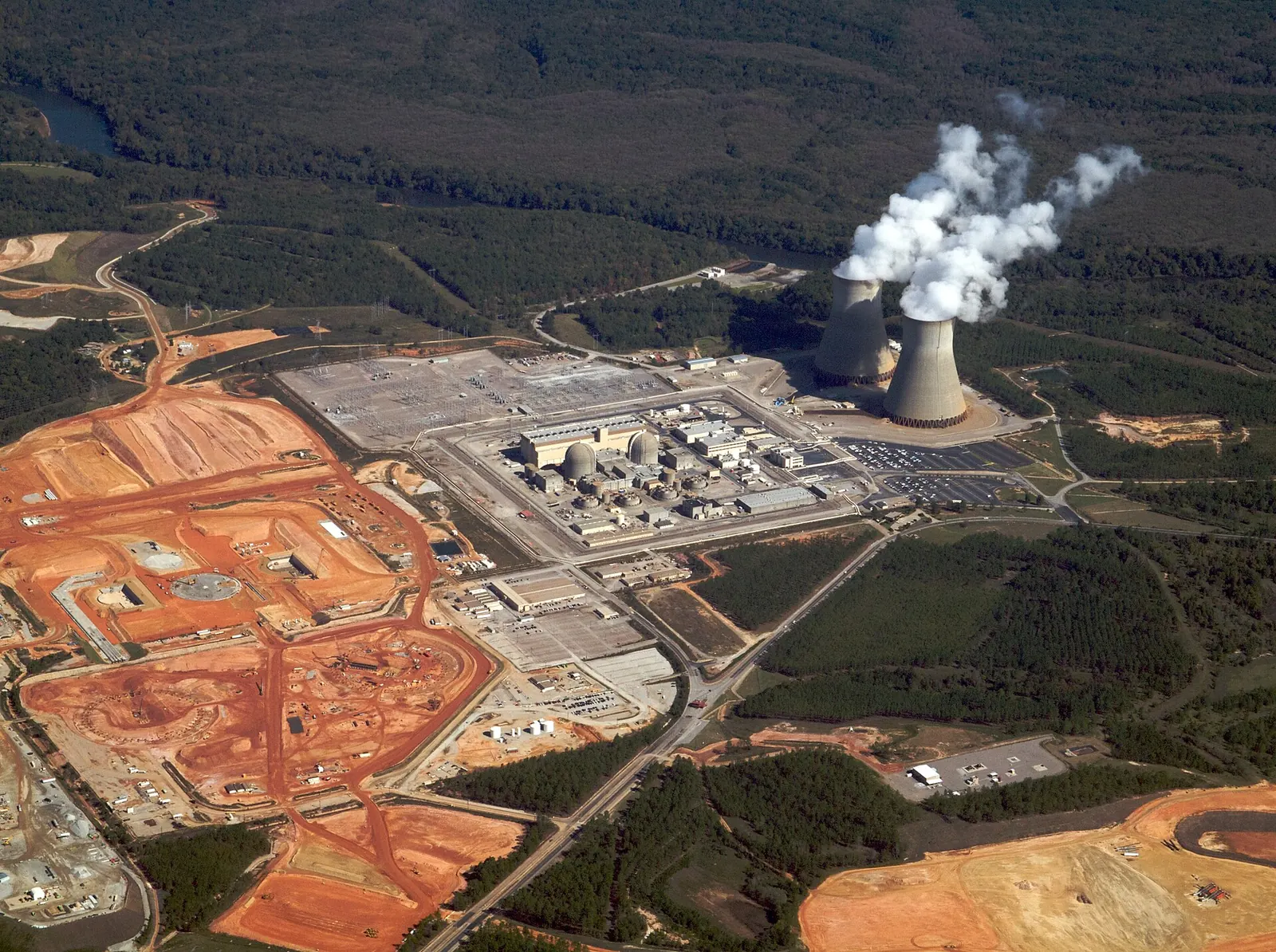
On April 29, 2024, Georgia Power declared that Unit 4 at Plant Vogtle had entered commercial operation, completing the first new nuclear units built from scratch in the United States in more than 30 years. Unit 3 had started commercial service on July 31, 2023. With four reactors now running near Waynesboro, Georgia, Vogtle is the largest generator of clean electricity in the country, expected to produce more than 30 million megawatt hours a year. Each of the new AP1000 units has a capacity of about 1,114 megawatts, enough, according to the utility, to serve roughly 500,000 homes and businesses for 60 to 80 years.
The achievement is real, and so is the cost. The Associated Press reported that the two units came in seven years behind schedule and at a total cost of nearly USD 35 billion, including USD 31 billion spent by the four owners and USD 3.7 billion that Westinghouse paid the owners to walk away from construction after its 2017 bankruptcy. The original estimate was USD 14 billion, with completion expected in 2017. Our view is that Vogtle should be treated neither as a triumph to be repeated as it was nor as proof that large reactors cannot be built in America. Its value lies in the lessons it offers about how to finance, contract and regulate the next projects, and in the fact that much of the first-of-a-kind cost has now been paid.
What went wrong
The Vogtle expansion was approved by the Georgia Public Service Commission in 2009 and began construction under a fixed-price contract with Westinghouse and its construction partners. The AP1000 design was new, and construction started before the design was complete. Modules fabricated off site arrived late or with defects, the US supply chain for nuclear-grade components had withered after decades without new orders, and the construction workforce had little nuclear experience. Westinghouse's bankruptcy in 2017, caused largely by losses on Vogtle and the abandoned V.C. Summer project in South Carolina, forced the owners to take over management of construction.
The pandemic added further delays, and testing found problems with electrical cables and other systems that required rework. Each delay raised financing costs, because the utilities were paying interest on a growing balance of capital spent on a plant not yet producing power.
What went right
By the time Unit 4 was finished, the project team had learned a great deal. Unit 4 was built faster than Unit 3, and the work force, suppliers and regulators had worked through the problems of a first build. The Nuclear Regulatory Commission's combined license process, which issues a single license for construction and operation, functioned as designed for the first time, even if the process was slow. The plant now provides firm, carbon-free power in a region with fast-growing demand.
At its peak, the site employed more than 9,000 workers, and the new units created around 800 permanent jobs. That workforce and its experience is a national asset. One of the costliest consequences of the long gap in US nuclear construction was that this knowledge had to be rebuilt almost from zero.
Who paid
Georgia Power customers have been paying for part of the project through their bills for years, under a state law allowing utilities to recover financing costs during construction. The Georgia PSC approved further rate increases as the units came into service. Municipal and cooperative co-owners, including Oglethorpe Power, MEAG Power and Dalton Utilities, passed costs through to their own customers. The episode shows how a regulated utility model can carry very large projects, but also how it shifts the risk of overruns onto ratepayers who had no say in the contracting decisions.
The case for the next AP1000
There is now a strong argument that the next AP1000 units would cost much less. The design is complete, the supply chain has been partially rebuilt, and the construction sequence is understood. Energy Secretary Jennifer Granholm used a visit to the site to call for more nuclear capacity, and the federal government has expanded support through the Inflation Reduction Act's production and investment tax credits, which are available to nuclear plants, and through the Department of Energy's Loan Programs Office. The Department of Energy's own analysis has argued that follow-on units at sites with existing infrastructure could be built far more cheaply than Vogtle.
The risk is that the knowledge built at Vogtle disperses before another project starts. Workers move to other industries, suppliers close their nuclear lines, and project managers retire. If the next large reactor order does not arrive within a few years, much of the learning will be lost again.
Lessons for the next projects
First, design must be complete before construction starts. Second, the risk of cost overruns should be shared in a way that reflects who can control it. Fixed-price contracts collapsed when the contractor could not absorb the losses. Third, no single utility should carry the risk of a first-of-a-kind or early-series project alone. Consortiums of utilities, federal cost-overrun insurance or state backstops can spread the risk. Fourth, a program of several units of the same design, ordered together, is what drives costs down, as countries such as South Korea have shown. One-off projects rarely do.
What this means for buyers of power
For large electricity users looking for firm, carbon-free supply, Vogtle shows that nuclear power is achievable but that the price depends heavily on how the project is structured. Long-term power purchase agreements with creditworthy buyers can help finance new units and reduce the burden on residential ratepayers. Corporate buyers interested in 24/7 clean electricity should engage early with utilities and developers, because the next large reactor will need committed offtake to get financed.
Our assessment
Vogtle Units 3 and 4 are a costly but valuable achievement. They demonstrate that the United States can still build large reactors, and they provide firm clean power for decades. The next projects will succeed only if the lessons on design completion, risk sharing and serial construction are applied quickly, while the workforce and supply chain that Vogtle rebuilt are still in place.