
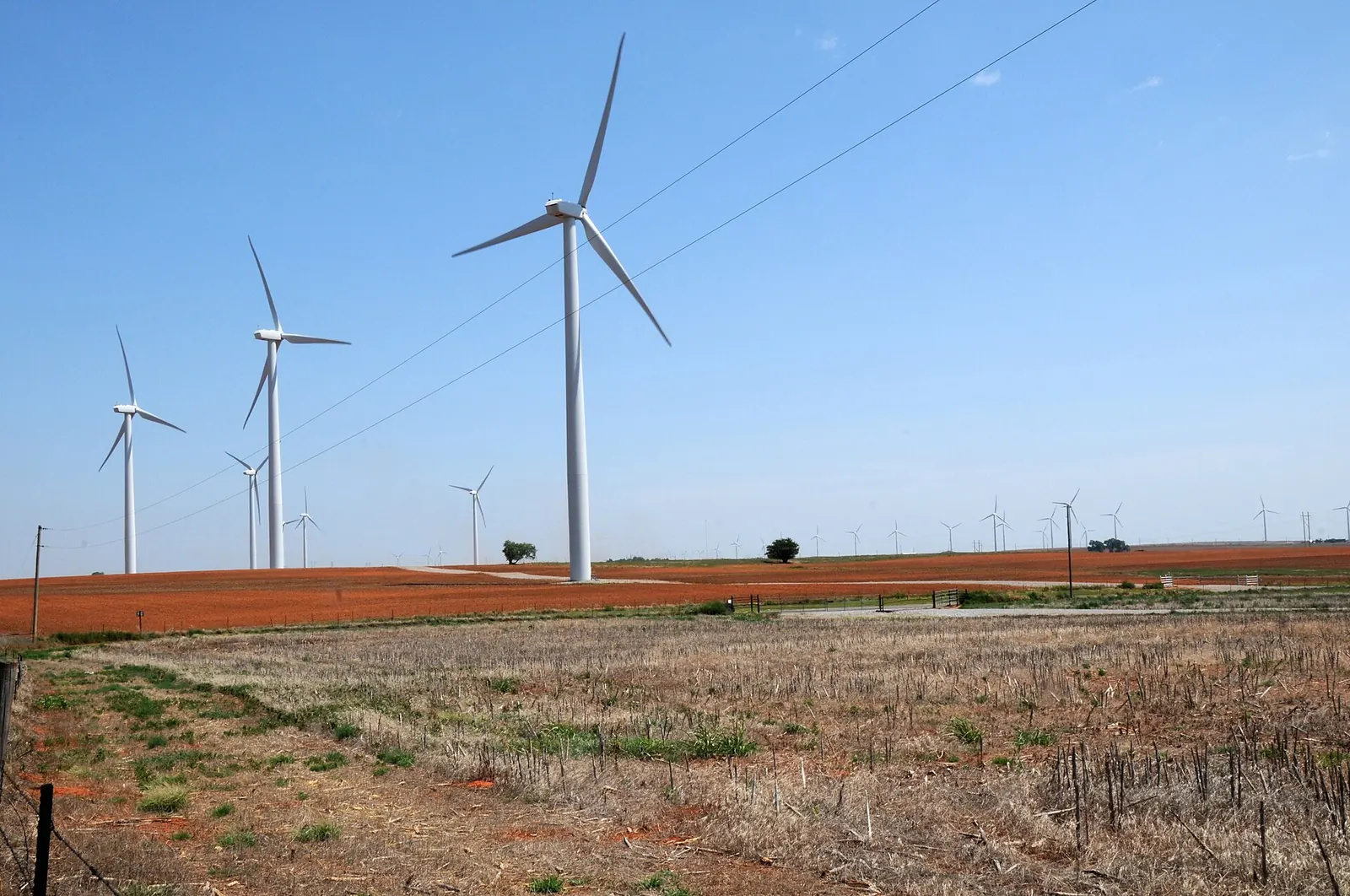
In 2023, grid operators in the Southwest Power Pool and the Midcontinent Independent System Operator curtailed an hourly average of 800 megawatts of wind generation, compared with less than 200 MW in 2019. Curtailment means a wind farm that could have generated was told not to. The energy was available, the turbines were spinning or could have been, and the system did not take it.
Most of the commentary on this trend focuses on wind. We think the more useful frame is transmission. The Midwest has built wind faster than it has built the wires to carry it, and curtailment is the price of that gap. The same pattern is now beginning to appear with solar, and with batteries that are increasingly being sited to soak up the excess.
The scale and the split
The two markets are quite different. Wind made up 36% of SPP's total generation in 2023 and 15% of MISO's. Average hourly curtailment in SPP rose from 136 MW in 2019 to 1,097 MW in 2023. In MISO it rose from 242 MW to 508 MW. Curtailments were actually lower in 2023 than in 2022, but the Energy Information Administration attributes that mainly to weaker wind, not to fewer constraints.
The EIA lists two reasons for curtailment. Oversupply happens when generation exceeds demand. Congestion happens when there is not enough transfer capacity to move power along its preferred path. On very windy days in particular locations, transmission is often insufficient to carry the large amount of wind being produced. Wind is curtailed first because it is cheaper and faster to shut down and restart than other generators.
In practice, congestion is the larger part of the story in both markets. Wind farms are concentrated in the western parts of SPP and MISO, where land is cheap and wind is strong. Demand is concentrated further east and in cities. The lines between them were built for a different system.
Winter storms show the pattern clearly
MISO congestion often occurs during winter storms, when high winds coincide with transmission constraints. That is a revealing detail. Winter storms are precisely the conditions in which the grid needs every available megawatt. If wind farms are generating strongly but cannot deliver power because lines are full, the system is losing energy in the hours it can least afford to.
The EIA notes that curtailments in winter 2023 to 2024 were lower than in the two previous winters, partly because of better resource planning and congestion management during storms. That is real progress, but it is operational. It manages the constraint more cleverly. It does not remove it.
The coal comparison
There is a revealing contrast in the neighboring PJM market. Coal-fired plants in PJM ran at just 34% of capacity in 2023, compared with 56% in 2013. Coal produced 14% of PJM's generation in 2023 while making up 18% of its capacity. The main cause is competition from efficient gas combined-cycle plants, whose capacity in PJM has doubled since 2013.
The comparison matters because it shows two very different reasons that capacity can sit idle. PJM's coal fleet runs less because it is expensive relative to alternatives. The Midwest's curtailed wind runs less because it cannot reach customers, even though it is the cheapest resource available. The first is the market working. The second is the market being blocked.
Batteries as a partial answer
One response to curtailment is to store the energy locally and release it later, when lines have room. Utility battery data from the EIA show this is the most common use case for US storage. At the end of 2023, utilities reported operating 575 batteries with a combined capacity of 15,814 MW, and they plan to add 35,953 MW by the end of 2028. Arbitrage, buying low and selling high, is the most commonly reported application, along with grid stability services.
In a congested wind region, arbitrage effectively means charging when local prices collapse because of excess wind, and discharging when the congestion clears. That turns some curtailed wind into delivered energy. It is a useful patch, and it can be built faster than new high-voltage lines.
But storage only shifts energy in time. If the congestion is structural, so that the lines are full for many hours of many days, a battery fills quickly and then has nowhere to send its stored energy until the constraint lifts. Batteries reduce curtailment at the margin. They do not replace the wires.
Why the transmission is slow
High-voltage lines across multiple states take a decade or more to plan, permit and build. Cost allocation, deciding who pays for a line that benefits several regions, is often the hardest part. MISO approved a first tranche of long-range transmission projects in 2022 and has been working on further tranches, and SPP has its own planning processes. These are significant steps. But the projects they approve will not be in service for years, and wind capacity has continued to grow in the meantime.
The Federal Energy Regulatory Commission's Order No. 1920 on long-term regional transmission planning, issued in May 2024, requires regions to plan over a longer horizon and to consider a wider range of benefits. Its effect in the Midwest will depend on how it is implemented and on whether cost allocation disputes can be resolved faster than in the past.
The cost of waiting
Curtailed wind is not free. Wind farms are often paid through production tax credits or long-term contracts that depend on delivered output. When they are curtailed, they lose revenue, and the expected cost of curtailment feeds into the price of future projects. Customers lose as well, because the energy that would have displaced higher-cost generation is not used.
There is a simple way to state the problem. The Midwest has some of the best wind resources in the world and has already built a large fleet to use them. The binding constraint on using more of that energy is now the transmission network. Every year of delay is a year of energy thrown away.