
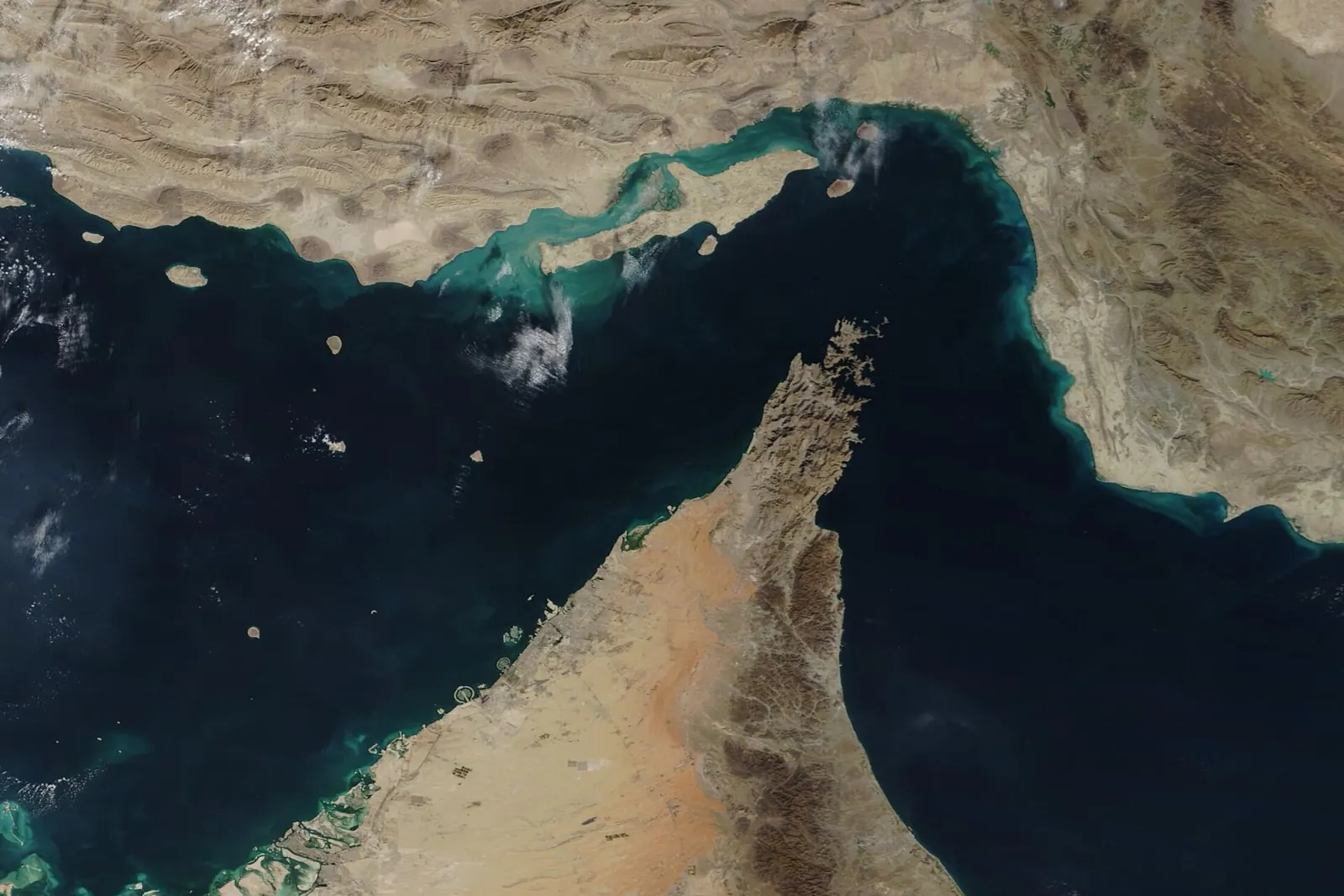
Middle East oil and gas supply security in 2024 must be described with two straits in view. Bab el-Mandeb and the Red Sea corridor have already forced tankers and LNG carriers onto the Cape route, cutting oil flows through Bab el-Mandeb to an average of 4.0 million barrels per day in 2024 through August from 8.7 million barrels per day in full-year 2023, according to EIA analysis of Vortexa data. Cape flows rose to 9.2 million barrels per day in the first eight months of 2024 from 6.0 million barrels per day in 2023. That is a live disruption. The Strait of Hormuz, by contrast, remained the world's primary oil chokepoint, with 2023 oil flows averaging 20.9 million barrels per day, about 20% of global petroleum liquids consumption, and around one-fifth of global LNG trade also transiting Hormuz in 2023.
Conflating the two chokepoints produces bad policy. Red Sea risk lengthens voyages between Asia and Europe and raises freight. Hormuz risk, if it materialised at scale, would threaten loadings from the Persian Gulf producers themselves. Spare capacity outside the Gulf cannot quickly replace twenty million barrels per day. That asymmetry is why Hormuz scenarios dominate genuine security planning even when Red Sea headlines dominate the news feed.
Saudi Arabia, the UAE, Kuwait, Qatar, Iraq and Iran sit behind Hormuz geography in different ways, with some pipeline bypass options of limited scale relative to seaborne volumes. Qatar's LNG is particularly exposed in share-of-global-LNG terms because a large fraction of world LNG trade originates in the Gulf. The EIA's 2023 framing that around one-fifth of global LNG moved through Hormuz is the right order of magnitude for planners to hold in their heads. European and Asian buyers who diversified away from Russian pipeline gas toward LNG simultaneously raised their sensitivity to Gulf maritime risk. That trade-off was accepted for good reasons in 2022; it should not be forgotten in 2024.
Iranian production and export behaviour under sanctions remains a wild card for balances, even when official OPEC+ math excludes or sidelines those barrels. EIA noted Iranian total petroleum and other liquids production averaged 4.0 million barrels per day in 2023, up from a recent annual low below 3.0 million in 2020, with almost 2.9 million barrels per day as crude. Enforcement intensity changes effective supply. Markets price that uncertainty continuously.
Saudi output averaged 9.5 million barrels per day of crude and condensate in 2023, with the Kingdom as OPEC's top crude producer and the world's top crude exporter that year, per EIA. Voluntary cuts in 2024 mean actual production sits below capacity, which is precisely what creates usable spare capacity for shock response. Spare capacity is an insurance asset for the global system, funded, in practice, by Saudi volume sacrifice. Importers who complain about price defence should also recognise who holds the surge barrels.
August 2024 sits after months of Red Sea rerouting and amid elevated regional military risk. Brent briefly reached 81 dollars per barrel on 7 October 2024 after Iran's early October attacks on Israel, with 79 dollars on 10 October, as EIA later noted. Even before those autumn prints, August planners should have been marking geopolitical risk premiums into landed-cost models rather than treating flat price as a pure supply-demand residual.
Pipeline politics eastward also matter. Russian pipe gas into China via Power of Siberia affects Chinese LNG call, which affects Atlantic LNG availability for Europe. Middle East supply security is therefore entangled with Eurasian pipeline geopolitics. A global energy security memo that stops at Hormuz and ignores that coupling is incomplete.
What can importers actually do? Diversify supply sources across basins. Maintain storage. Support naval protection of shipping where lawful and coordinated. Invest in demand reduction so that a temporary supply shock hurts less. Develop non-Gulf LNG and pipeline options where commercially rational. None of these steps eliminate Hormuz risk. They reduce the damage function.
For the energy transition, Gulf producers are simultaneously oil exporters, LNG exporters, and increasingly investors in renewables and blue-hydrogen narratives. Transition diplomacy that treats them only as obstacles misunderstands their fiscal incentives. Transition diplomacy that ignores chokepoint risk misunderstands physics. Making the transition add up requires both the climate arithmetic and the maritime arithmetic.
Engineers should model not only lost volumes but delayed volumes. A strait closure or severe restriction creates queueing, freight spikes, and destination reshuffling. Price spikes can occur even when alternative barrels exist, because logistics cannot reallocate instantly. Time is a physical variable in energy security. August is a good month to remember that, while Northern Hemisphere storage fills and winter approaches for gas buyers.
The measurement problem deserves candour. Public debate often demands a single number when the honest answer is a range conditioned on weather, compliance, and policy. Analysts who refuse to give false precision are not being evasive; they are being professional. Where the evidence is quantitative, the figures here are drawn from named institutional sources; where it is qualitative, the analysis stays qualitative. Work of this kind is only useful to engineers and finance ministries if that line is held.
Institutional process also matters. Ministerial meetings, regulator reports, and statistical releases arrive on calendars that do not match the news cycle. A decision delayed by a quarter can matter more than a speech that trends for a day. Readers should track the scheduled decision points and the secondary-source compliance tables as carefully as they track spot prices. Spot prices are the symptom. The schedules and the physical balances are the mechanism.
For firms, the practical response is layered: contractual flexibility where it can be bought at reasonable cost; operational buffers in storage and logistics; and scenario planning that includes corridor disruption and producer-policy shifts as base cases rather than footnotes. For governments, the response is transparent contingency planning and honest communication about bill impacts. Pretending that global energy markets can be insulated by rhetoric alone is not strategy.
Keep Hormuz and Bab el-Mandeb on separate lines of the risk register, with separate probability and impact estimates, and revisit both whenever regional escalation ladders change.
None of this analysis requires a villain. Markets clear under constraints. The constraints in 2024 through 2026 include geopolitics at sea, producer coordination onshore, demand substitution in transport, and the slow build-out of critical mineral supply chains for the equipment that substitutes. Treating those constraints as a single "energy crisis" slogan collapses distinctions that determine whether a policy works. Precision is not pedantry. It is how the transition is made to add up.