
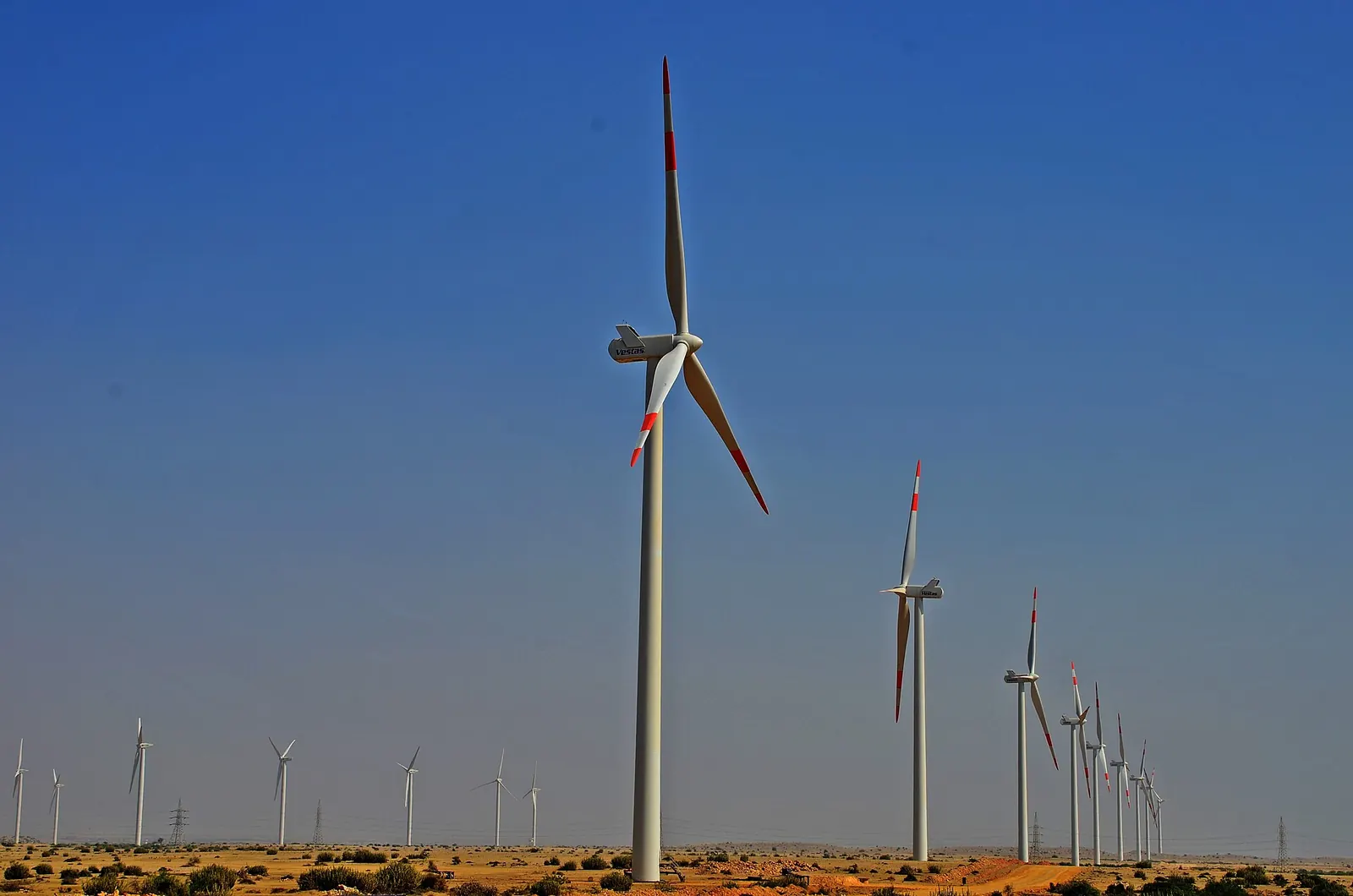
The Gharo-Jhimpir wind corridor in Thatta and Jamshoro is Pakistan's proven commercial wind province. By late 2024, thirty-six wind power plants with a combined capacity of around 1,845 megawatts had been installed there between 2013 and 2022 under Renewable Energy Policy 2006 pathways. Dawn's September 2024 field reporting made the operational contradiction plain: a corridor that can supply on the order of 1,800 MW in strong summer conditions was being instructed to curtail toward roughly 1,200 MW as part of a southern generation stack of about 4,500 to 4,800 MW from coal, nuclear and renewables. Turbines that look like a clean-energy success story from the motorway sit idle for reasons that are mostly wires and dispatch, not resource.
That concentration matters. Wind is a few percent of national capacity but a geographically correlated fleet. When the monsoon wind regime is strong, many plants peak together. Southern generation growth outpaced National Transmission and Despatch Company capability to move power north. Local 132 and 220 kV networks, overloaded interfaces, and stability concerns during variable injection compound the bottleneck. NTDC has pointed to seasonal variation in wind output as a grid-stability challenge. Investors reply that tariff approvals for these plants were conditioned on commitments to evacuate their energy, and that take-and-pay wind should be preferred to plants that bill capacity charges whether or not energy is used. Independent experts quoted in Dawn asked why the system would prefer capacity-charge plants when take-and-pay wind can deliver energy without the same fixed liability. Both the stability concern and the contractual point can be true at once. The system still needs physical transfer capacity.
Contractual consequence is Non-Project Missed Volume. When the offtaker cannot take available energy for reasons defined in the energy purchase agreement, NPMV compensation is owed. Sector analyses covering FY2024 have quantified wind curtailment on the order of 1,337 gigawatt-hours, with NPMV-related loss reported around Rs 40 billion and replacement-generation costs adding a further Rs 22.73 billion in one renewables-focused decoding of the power purchase price. Those figures are fiscal evidence that curtailment is not a private inconvenience for sponsors. It is a consumer-facing cost of inflexibility, and excluding NPMV from formal PPP planning understates the bill. Transition Economics Institute treats NPMV published in attributable sector monitors as a planning signal: every rupee of NPMV is a rupee that better transmission or storage might have avoided. Producers have also argued that NPMV formulas do not always restore actual high-wind-season revenue, which is a separate drafting fight inside energy purchase agreements.
Dawn also documented payment stress beyond curtailment. Plant owners described incomplete settlement for energy that did reach the grid, with billed amounts accumulating at the Central Power Purchasing Agency and delayed-interest provisions going unpaid. A representative example in that reporting put a 50 MW plant's energy bill near Rs 2.5 billion over four to five months. Circular-debt mechanics are not this article's primary subject, but unpaid wind invoices interact with investor willingness to fund the next gigawatt. Foreign lenders watch both curtailment logs and receivables aging. Industry associations have warned that sustained curtailment plus weak settlement can push projects toward covenant stress, an outcome that would raise the cost of capital for every subsequent renewable auction.
Grid remedies are visible on paper and partly in the ground. Jhimpir-II 220/132 kV strengthening was energised earlier in the decade to support the Jhimpir cluster. A Gharo 220/132 kV gas-insulated substation, supported by a 27 million euro KfW commitment under the Pakistan-German Climate and Energy Partnership, is designed with two 250 MVA 220/132 transformers, 220 kV bays toward Jhimpir and Dhabeji, and 132 kV bays for Gharo cluster plants. Broader 500 kV south-north relief remains essential. Dawn reported Planning Ministry approval of a Rs 189 billion Matiari to Rahim Yar Khan 500 kV line, with Rs 17 billion allocated in the FY2024-25 budget. The Private Power and Infrastructure Board has pointed to K-Electric's Dhabeji interconnection path as another evacuation relief valve for coastal wind. Until those wires commission, new wind letters of intent in the same corridor are financially and electrically suspect.
Policy design made part of this mess. Poorly sequenced capacity additions in the south, including wind projects approved when evacuation was already tight, turned resource abundance into a congestion externality. ARE Policy 2019's shift toward competitive bidding and interconnection-ready nodes was meant to stop orphaned megawatts. Implementation still auctions or licenses volume faster than transmission plans build transfer. Sindh Energy Department tallies cited in Dawn put at least twenty-seven renewable projects totaling 1,875 MW at various approval stages, including legacy projects caught between 2006-policy approvals and later one-time competitive bidding requirements. Sponsors argue that unrealistically low benchmark tariffs chill bids. Planners argue that Pakistan cannot afford another round of expensive take-or-pay. The adult resolution is firm nodes, honest benchmarks, and published curtailment risk allocation before financial close.
Modern bids need site-specific met masts, lidar campaigns, and wake-loss models, not only atlas averages from earlier decades. Turbine technology has moved to larger rotors and higher hubs. Repowering older corridor machines may eventually yield more gigawatt-hours on the same land if interconnection allows. Grid Code fault-ride-through and forecasting obligations are now central to system-operator practice. Forecasting accuracy drives imbalance costs under a future competitive market and under residual single-buyer dispatch alike. Corridor plants should feed the operator with farm-level forecasts at Grid Code horizons. Penalties for chronic bias must be symmetrical with NPMV rights when the system cannot evacuate.
Battery storage sited in the south is part of the same conversation. Storage cannot substitute for missing 500 kV transfer capacity, but it can absorb midday or high-wind surplus locally and reduce some instruction-to-curtail events when the constraint is local rather than corridor-wide. Hybrid wind-solar-storage candidates should be scored in IGCEP with explicit curtailment assumptions so sponsors do not discover the bottleneck only after COD.
Community relations in Thatta and Jamshoro, land-lease fairness, and local hiring affect whether additional gigawatts can be sited even when wires improve. Curtailment politics will otherwise harden into provincial grievance. Transition Economics Institute's position is straightforward. The corridor proved wind works in Pakistan. It also proved that ARE Policy megawatts without transmission megawatts become NPMV invoices. Auction design should sell interconnection-ready nodes, not abstract provincial quotas. Measure success by evacuated gigawatt-hours and declining NPMV, not by nameplate tallies that look good in investment roadshows.