
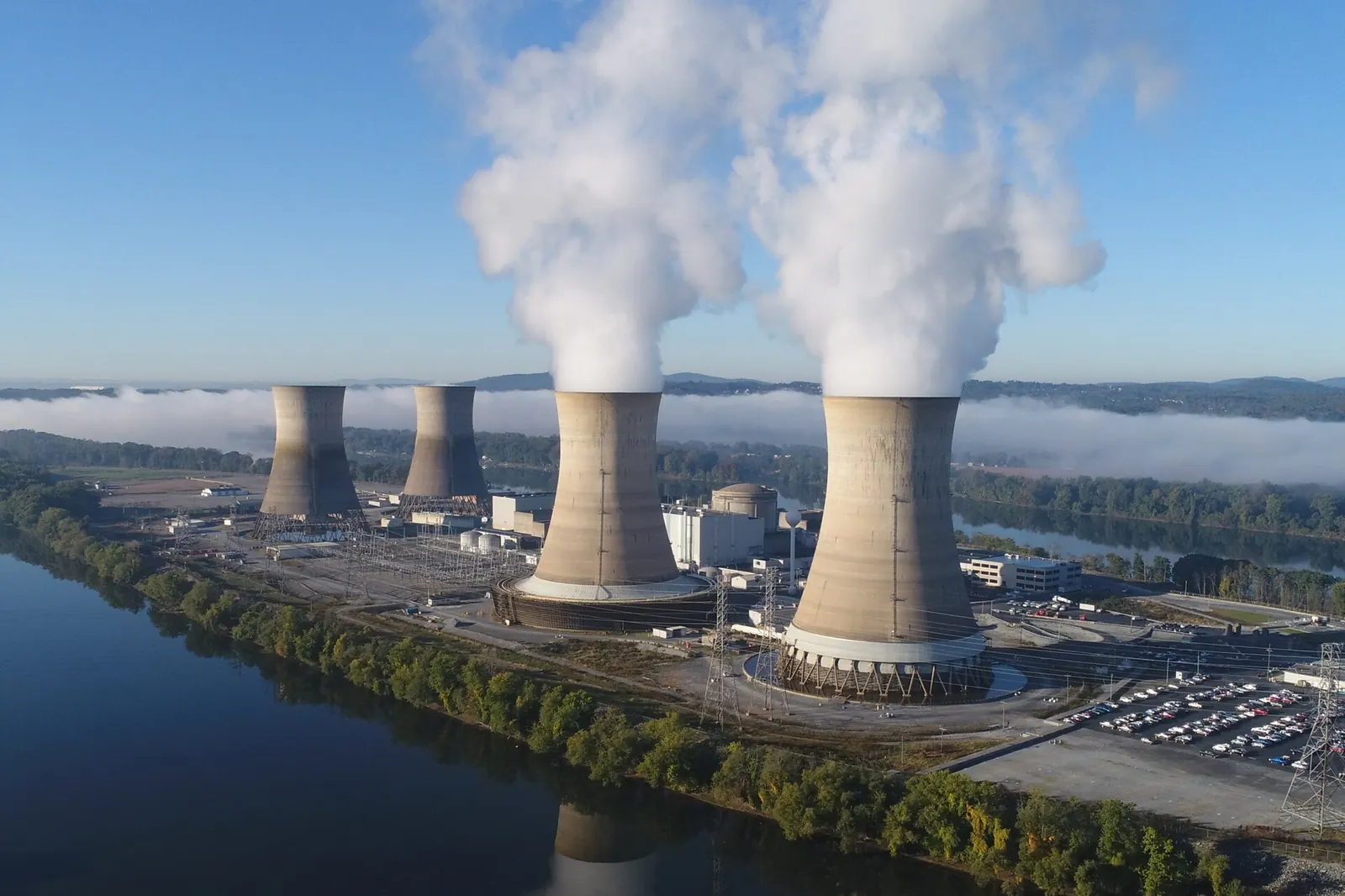
Two contracts signed in 2024 changed how the US power sector talks about data centers. In March, Amazon Web Services agreed to buy up to 960 megawatts of capacity from Talen Energy's Susquehanna nuclear plant in Pennsylvania. In September, Constellation Energy announced a 20-year power purchase agreement to supply Microsoft data centers in the mid-Atlantic from Three Mile Island Unit 1, a reactor that returned to service in 1985 after the 1979 accident at the adjacent Unit 2 and was retired in 2019 because its then owner said it was no longer profitable.
Meanwhile in Texas, the grid operator's queue of large flexible loads, mostly data centers and cryptocurrency mines, has grown to a size that makes even optimistic utility forecasts look cautious. These developments share a cause. Computing companies want large amounts of reliable, low-emission power quickly, and they are willing to pay for it outside the normal utility planning cycle. The consequences for everyone else on the grid depend on how those deals are structured.
Why nuclear, and why existing plants
The Energy Information Administration's summary of the logic is straightforward. Nuclear plants are costly to build but cheap to run, a single reactor typically has 800 MW or more of capacity, and they produce electricity without directly emitting carbon dioxide. For technology firms with self-imposed emissions targets and fast-growing power needs, an existing reactor offers something wind and solar cannot: round-the-clock output at scale, from a single site, available now.
New reactors take a decade or more to build. Existing ones are already licensed, connected and staffed. The Three Mile Island deal goes one step further, betting that a retired reactor can be restarted, which would add capacity to the grid rather than redirecting it.
The uncertainty is built into the contracts
The Susquehanna deal is worth reading closely, because its structure reveals how unsure even the buyers are about their own demand. Rather than taking the full 960 MW at once, AWS will ramp up its share in 120 MW increments over several years, and it has a one-time option to cap its commitment at 480 MW. The EIA notes that this reflects uncertainty about how quickly and how far data center demand will grow.
That is a sensible hedge for the buyer. For grid planners, it is a signal that headline numbers for data center demand should be treated as ranges, not forecasts.
The Texas picture
The scale in Texas is even larger and even less certain. The Electric Reliability Council of Texas, which manages 90% of the state's load, set up a program in mid-2022 to approve large flexible load customers, defined as those with expected peak demand of 75 MW or more. As of the EIA's September analysis, ERCOT had approved 5,479 MW of such load, 1,570 MW of it in the previous 12 months.
For its forecasts, the EIA assumes that ERCOT will have approved 9,500 MW by the end of 2025, 73% more than currently. Historically, these customers have used about 65% of their approved capacity. On that basis, the agency assumes total large flexible load consumption of 54 billion kilowatthours in 2025.
But the queue is much larger than the forecast. ERCOT's early September status update showed projects totaling about 26,500 MW applying to become operational by the end of 2025. Not all of that will be built, and not on that schedule. The gap between 26,500 MW of requests and 9,500 MW of assumed approvals is a measure of how hard it is to forecast this load.
Where the demand is landing
Earlier EIA analysis shows how concentrated the growth already is. US commercial electricity sales in 2023 were only 1% above 2019. But in the ten states with the most demand growth, commercial sales rose 10% over those four years, adding 42 billion kWh, while the other 40 states saw a combined decline of 28 billion kWh.
Virginia leads, driven by Dominion Energy's territory, where 94 new data centers have connected since 2019, drawn by a dense fiber backbone and four subsea cables. Texas follows, with cheap land and power attracting both data centers and crypto mining. North Dakota had the fastest relative growth, at 37%. Large states such as New York, Illinois and California have seen flat or falling commercial demand.
The question of who pays
The nuclear deals raise a specific issue. When an existing reactor's output is contracted to a single data center, particularly through an arrangement that places the load next to the plant, that output is no longer available to the wider market in the same way. If the plant previously supplied capacity to a regional market, the region has to replace it, at whatever price new capacity costs.
At the same time, the data center may continue to rely on the grid for backup, for voltage support and for transmission services, even if it draws power directly from the plant. Whether it pays a fair share of those costs depends on how utilities, grid operators and regulators treat these arrangements. That debate is under way at the Federal Energy Regulatory Commission and in several states.
The restart at Three Mile Island is a different case, because it adds capacity that was not on the system. If it proceeds on schedule, it increases supply for the region even as it serves a single buyer. Restarts are the clearest example of data center money creating new firm capacity rather than reallocating existing capacity.
What a good outcome looks like
Data center demand is not a problem in itself. It is a large new source of revenue for the power sector and a source of capital for new and restarted generation. The problem is the mismatch in timing. Computing companies can decide to build a campus in a year or two. Generation and transmission take much longer. If the demand arrives before the supply, prices rise for everyone and reliability margins narrow.
A good outcome would have three features. Large loads would bring their own supply, or pay for it, rather than drawing on existing capacity that other customers rely on. They would pay for the network costs they create. And they would be willing to reduce demand during grid emergencies, which the "flexible" in ERCOT's large flexible load category is meant to capture. The nuclear deals of 2024 are a start on the first. The second and third are still being negotiated.