
China imported 76.65 million tonnes of liquefied natural gas in 2024, according to the General Administration of Customs. That was up 7.7 per cent on 71.32 million tonnes in 2023, enough for China to remain the world's largest LNG importer, but still short of the 2021 peak of about 78.9 million tonnes. Two years after a 2022 collapse in Chinese LNG buying, imports have recovered most of the lost ground without breaking new records.
That outcome has a clear interpretation. The marginal tonne of LNG into China now competes with pipeline gas that is cheaper and contracted, with domestic production that keeps rising, and with a power sector that is adding clean capacity at a pace that limits the role of gas in generation. Our view is that Chinese LNG demand has become more price-elastic than most supply forecasts assume, and that exporters counting on China to absorb the coming wave of new liquefaction capacity should treat that as a central risk rather than a tail risk.
Pipeline gas reaches full volume
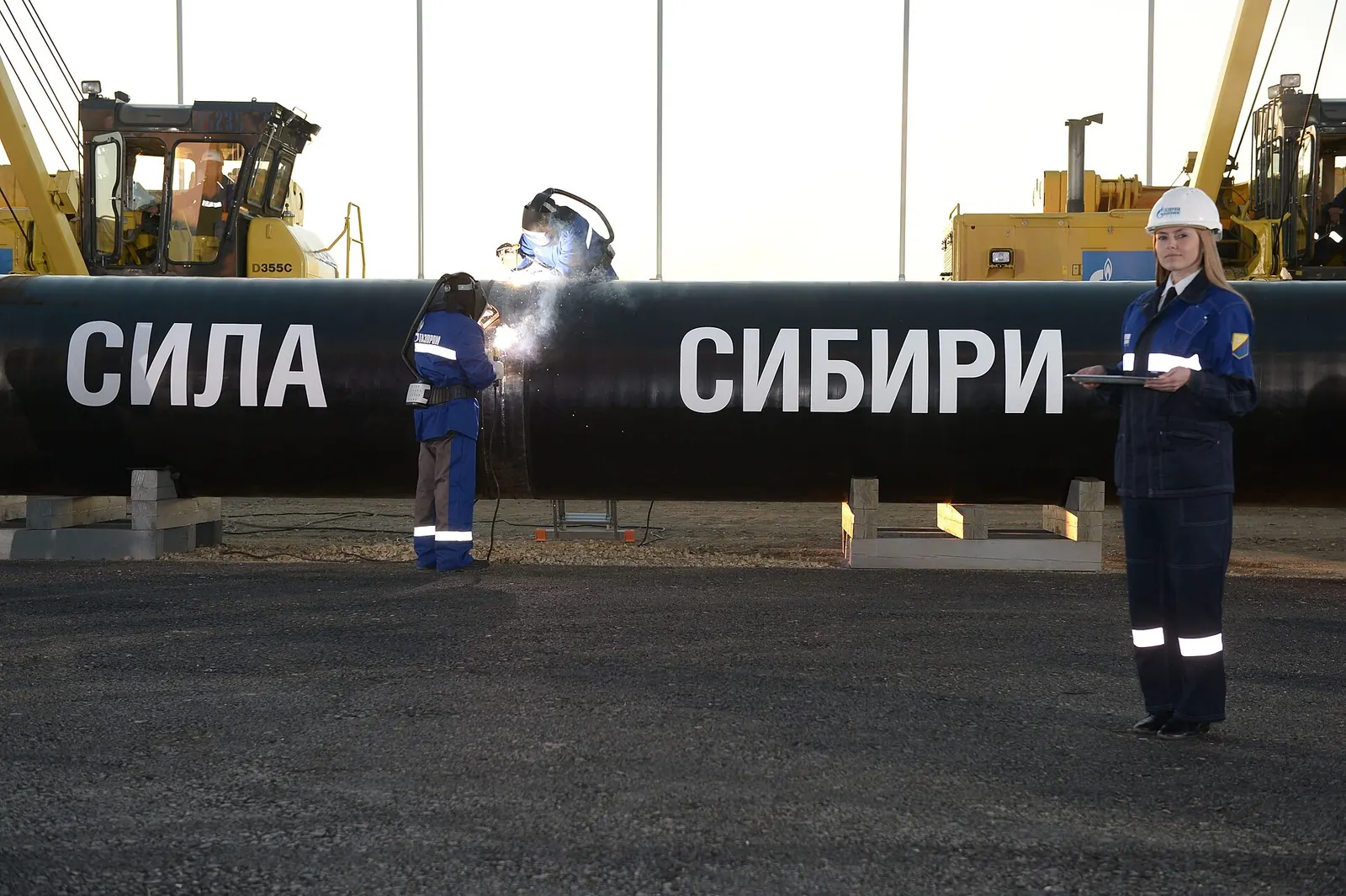
The most important change on the supply side in 2024 was the Power of Siberia pipeline. Interfax reported that Gazprom's exports to China through the line reached the full design capacity of 38 billion cubic metres a year in December 2024, ahead of schedule. Over the full year, Gazprom supplied about 31 billion cubic metres, exceeding its contractual plan of 30 billion cubic metres.
That increment matters at the margin. A few billion cubic metres of additional pipeline gas in 2025, compared with average 2024 flows, is equivalent to several million tonnes of LNG. Pipeline gas from Russia is also understood to be priced below spot LNG for most of the past two years. Chinese importers with take-or-pay pipeline obligations will use that gas first, and buy LNG only where it is competitive or where coastal demand is out of reach of the pipeline network.
Power sector: gas squeezed from both sides
China's electricity data for 2024, published by the National Energy Administration on 21 January 2025, show why gas struggles to win share in power. The country added about 277 GW of solar and about 80 GW of wind, taking solar capacity to roughly 887 GW and wind to nearly 521 GW. Enerdata's summary of the same release notes that generation rose 4.6 per cent to 9,418 TWh, with thermal output up only 1.5 per cent while solar generation rose 28 per cent and wind and hydro both rose about 11 per cent.
Electricity consumption grew faster than generation, at 6.8 per cent to 9,852 TWh, and was led by services and households. In that environment, gas plants are used primarily for peaking and for balancing coastal grids during demand spikes, not for baseload. They compete with coal plants that now receive capacity payments for availability and with a rapidly growing fleet of batteries. Gas-fired power remains a growth sector in China, but it is not the growth engine that LNG marketers once hoped for.
Where Chinese LNG demand actually sits
The structural demand for LNG in China comes from coastal city gas distribution, industry in provinces far from pipeline supply, and peak-season heating. Those segments are sensitive to price. When Asian spot prices are low, city gas companies and industrial users switch from alternative fuels and LNG trucking volumes rise. When prices are high, as in 2022, they cut back sharply and Chinese importers resell cargoes into other markets.
This behaviour is reinforced by China's contract position. Chinese buyers signed a large number of long-term LNG contracts in 2021 to 2023, many indexed to oil or to Henry Hub. Once those contracts start delivering, importers will have a choice between taking contracted volumes for domestic use or reselling them. The more contracted LNG they hold, the more room they have to trade around the domestic market. That turns Chinese portfolio players into price setters in Asia, rather than price takers.
The 2025 test
Several large liquefaction projects in the United States, Qatar and elsewhere are scheduled to start in 2025 and 2026. A great deal of the case for that supply rests on Asian demand growth, and China has been the default answer. The 2024 data show a more cautious picture. Chinese LNG imports rose, but more slowly than in 2023, and remained below the 2021 level despite three years of economic growth and the reopening of the economy.
For 2025 we see three factors that point to subdued Chinese LNG growth. Pipeline imports from Russia will run at full capacity for the whole year. Domestic gas production continues to grow under policy pressure for self-sufficiency. And the power sector's clean additions will continue to limit gas burn, unless hydro output collapses in a drought.
Against that, there are two factors that could lift imports. A cold winter would raise heating demand, and a sustained fall in spot prices would bring back price-sensitive industrial users. If spot LNG falls towards levels where it competes with coal in coastal industry, China could absorb a meaningful share of new supply. That is precisely the condition under which exporters' margins are thinnest.
Trade policy as a wild card
There is one more factor to price in. China imposes tariffs on US LNG that have been in place since the trade disputes of 2018 and 2019. Chinese buyers have contracted large volumes of US-sourced LNG on a free-on-board basis, which allows them to resell rather than import those cargoes. Any escalation in US-China trade friction in 2025 would push more of that gas into Europe and other Asian markets, with Chinese portfolio players acting as intermediaries rather than consumers.
Our position
China's LNG imports in 2024 show recovery but not renewed growth, and the reasons are structural: pipeline gas at full capacity, domestic production rising, and a power sector in which clean generation meets most incremental demand. Chinese LNG demand is now best understood as a flexible residual that grows when prices fall and contracts when they rise.
For exporters, the implication is that China will take more LNG in a low-price world and less in a high-price one, which makes it a stabiliser for the global market rather than a guaranteed sink. For Chinese importers holding long-term contracts, the opportunity is to become trading houses as much as utilities. For energy security planners in other Asian markets, the lesson is that the competition for spot cargoes in a tight year will depend less on China's need for gas and more on its willingness to pay.