
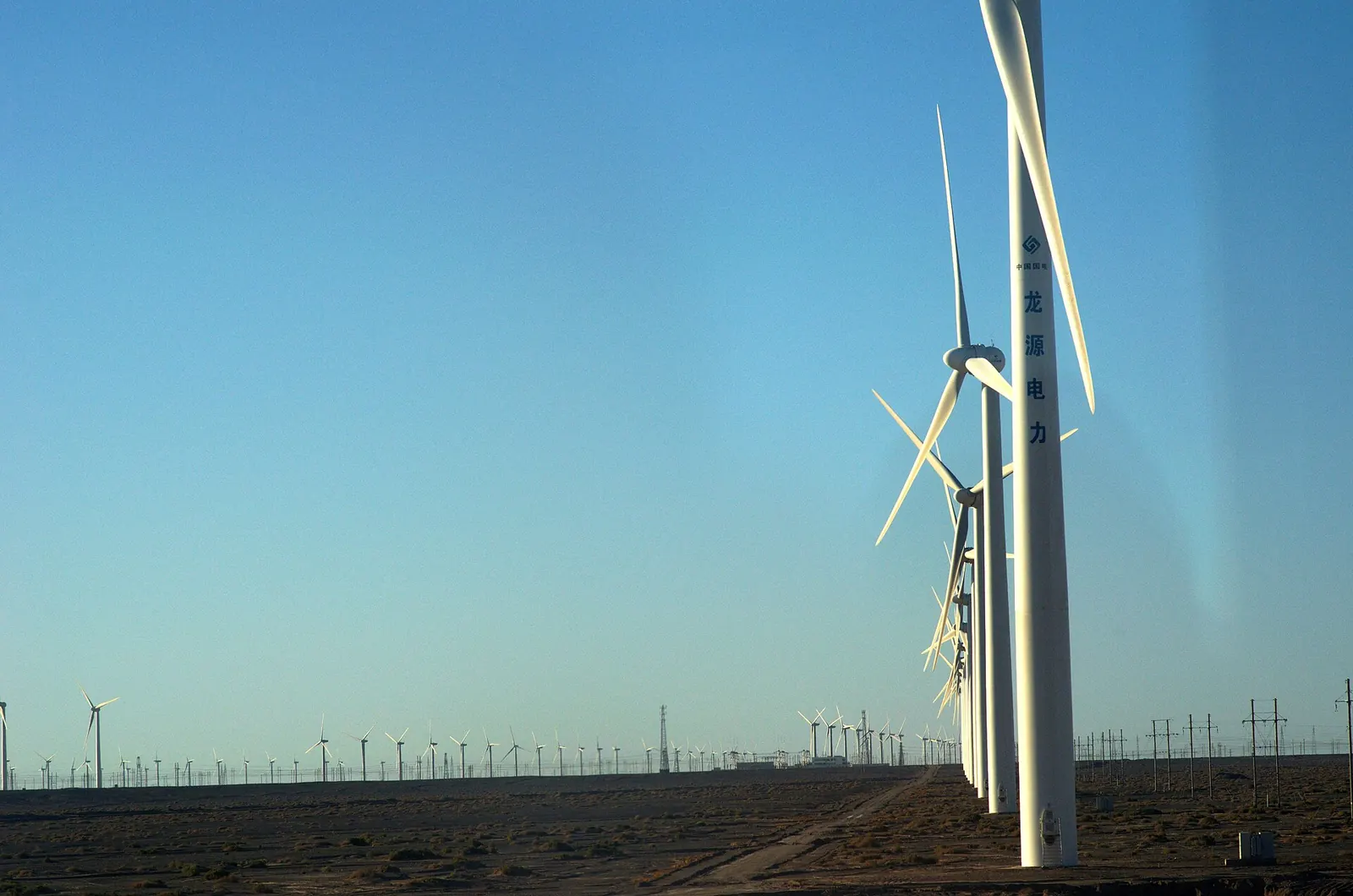
The National Energy Administration's year-end figures for 2025 mark the second capacity crossover in eighteen months. In mid-2024 wind and solar capacity overtook coal. By the end of 2025, according to the NEA's release of 12 February 2026, combined grid-connected wind and solar capacity reached 1,840 GW, 47.3 per cent of the national fleet, and for the first time exceeded all thermal capacity. China added more than 430 GW of wind and solar during the year, 120 GW of wind and 318 GW of solar, a 22 per cent increase on 2024 and another record.
The NEA's annual statistics, published on 29 January, put total generating capacity at about 3,890 GW, up 16.1 per cent. Solar capacity reached about 1,200 GW, up 35.4 per cent, and wind about 640 GW, up 22.9 per cent. Wind and solar generation grew 25 per cent and supplied 22 per cent of all electricity, helping push renewables to close to 40 per cent of generation.
These are extraordinary numbers, and the NEA is right to present them as the completion of every target in the 14th Five-Year Plan. Wind and solar capacity is now 3.4 times the level at the end of 2020, and their share of generation has risen by more than 12 percentage points over the period. But our reading of the 2025 data is that the constraint on China's transition has now shifted decisively from building capacity to using it. The gap between a 47 per cent capacity share and a 22 per cent generation share is the central policy problem for the 15th Five-Year Plan.
The shape of the 2025 build
The composition of additions changed in 2025. Wind additions of about 120 GW were the largest on record and well above 2024's roughly 80 GW. Solar additions of 318 GW were also a record, but the year was front-loaded. The rush to connect projects before 1 June under the market pricing reform known as Document 136 produced about 198 GW of solar in the first five months, including about 93 GW in May. That means solar additions in the seven months from June to December were roughly 120 GW, a much slower monthly pace than in the first half.
The shift towards wind is what the new pricing framework would predict. Under market exposure, wind's more even output profile earns higher average prices than solar's midday output. Developers have responded. A rising wind share in new capacity is a healthy sign for system balance.
Capacity share versus energy share
A 47.3 per cent share of capacity producing 22 per cent of electricity is not in itself a problem. Solar plants in China typically run around a sixth of the hours in a year at full output equivalent, and wind plants around a quarter. Thermal plants run far more. A gap between capacity and energy shares is a feature of variable generation everywhere.
The problem is the trend in the gap. If utilisation of wind and solar falls because the grid cannot absorb their output, every new gigawatt contributes less energy and displaces less coal. That is what curtailment does. And the evidence from 2025 suggests the pressure is building.
The curtailment signal
The NEA's own figures hint at it. Average utilisation hours across all generating plant fell by 132 hours year on year in the first five months of 2025, as capacity grew far faster than demand, and that pressure falls first on the plants with the lowest marginal cost and the least contractual protection, which are wind and solar. The framework announced in January 2025, which supports the absorption of more than 200 GW of new renewable capacity a year while keeping the utilisation rate at or above 90 per cent, already accepts curtailment of up to 10 per cent.
The root causes are institutional. Most coal generation is still sold under annual contracts with fixed prices and volumes. Inter-provincial transmission flows are largely set in advance. Neither arrangement rewards flexibility. Coal plants receive capacity payments for being available, but are not penalised for running when solar output is high. Until those rules change, more wind and solar will mean more curtailment, not proportionately less coal.
What the 15th Five-Year Plan must address
The 15th Five-Year Plan, covering 2026 to 2030, will be adopted at the National People's Congress in March. On the evidence of 2025, it needs to do three things.
First, set a clear direction for dispatch reform. Spot markets in every province, with coal plants paid for flexibility and energy at market prices, would allow the system to use renewable output that is currently wasted. National-level rules on inter-provincial trading would reduce the barriers that make one province curtail while its neighbour burns coal.
Second, prioritise grid and storage. Grid investment has been rising faster than generation investment since 2024, which is the right direction. Battery storage has grown rapidly, but much of it was built to meet approval conditions rather than to provide flexibility. Market pricing should change that, but only if storage is allowed to earn from price spreads and ancillary services.
Third, replace capacity targets with utilisation and emissions targets. A system with 1,840 GW of wind and solar does not need a target for more capacity as much as it needs a target for how much of that capacity's output is actually used. A curtailment ceiling below 10 per cent, monitored provincially and enforced, would focus policy on the right constraint.
Our position
China's 2025 power statistics confirm that the country can build clean capacity at a pace that no one forecast five years ago. Wind and solar now exceed all thermal capacity, and every 14th Five-Year Plan target was met. That achievement should not be understated.
But the next phase of the transition will be decided by operating rules, not installation rates. Rising curtailment is the warning sign. If the 15th Five-Year Plan addresses dispatch, market design and transmission as seriously as previous plans addressed capacity, China's emissions can begin a sustained decline. If it does not, the country will continue to build record volumes of wind and solar while coal generation refuses to fall.