
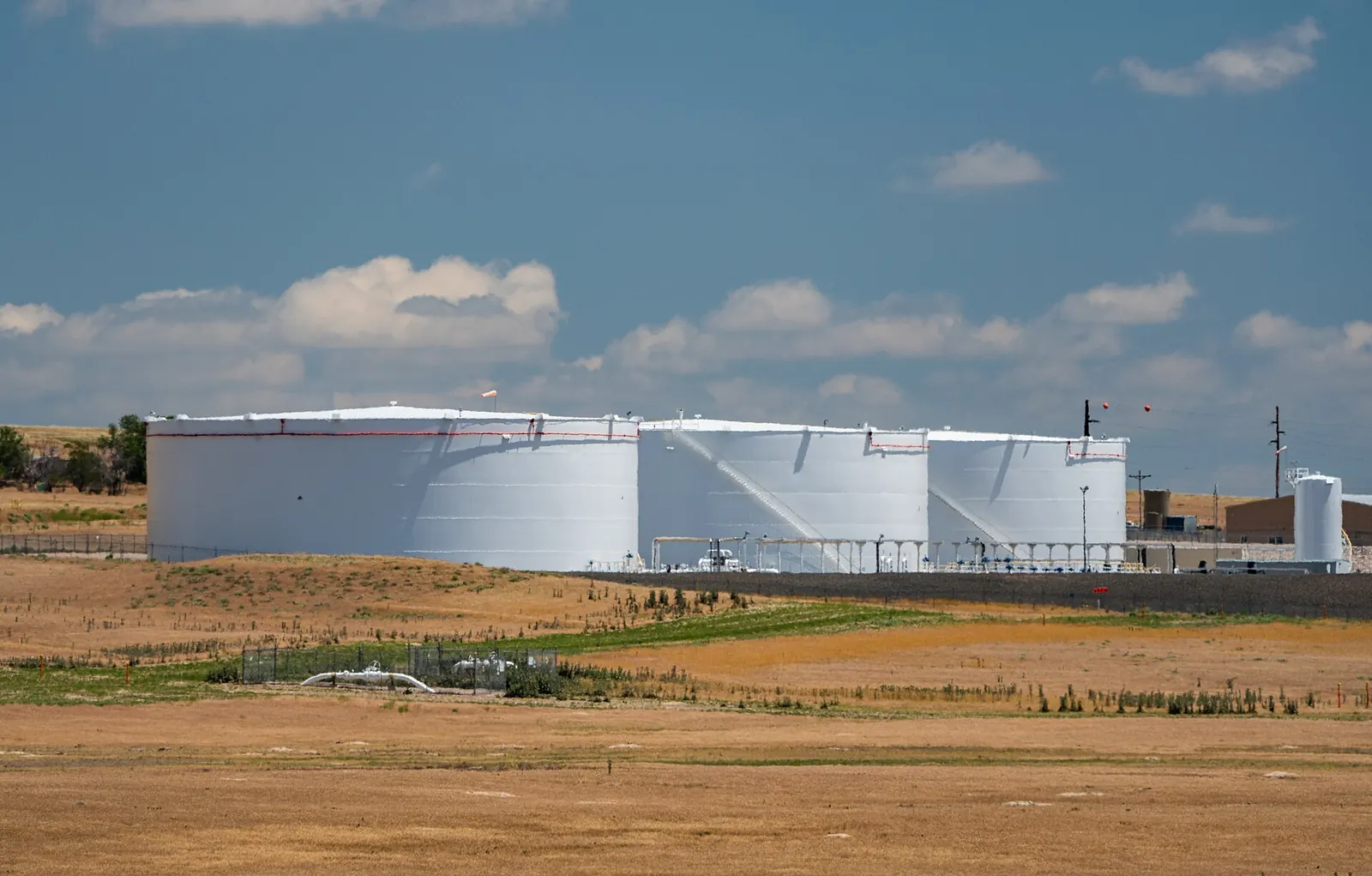
On 11 March 2026, the 32 member countries of the International Energy Agency unanimously agreed to make 400 million barrels of oil from emergency reserves available to the market, in response to the disruption caused by the war in the Middle East that began on 28 February. It is the sixth coordinated stock release in the agency's history, after actions in 1991, 2005, 2011 and twice in 2022, and by far the largest. The IEA said that export volumes of crude and refined products through the Strait of Hormuz had fallen to less than 10 per cent of pre-conflict levels, forcing producers across the region to shut in or curtail output. In 2025, an average of 20 million barrels a day of crude and products passed through the strait, around a quarter of the world's seaborne oil trade.
By 15 March, member countries had submitted implementation plans totalling about 412 million barrels, according to the IEA's update: 271.7 million barrels of government stocks, 116.6 million of obligated industry stocks and 23.6 million from other sources. The United States accounts for 172.2 million barrels of government crude. Asia-Oceania members are releasing immediately, while stocks from the Americas and Europe become available from the end of March. Our view is that the release is a well-designed and necessary buffer, but its limits should be understood clearly. It cannot replace Hormuz flows for long, and it highlights a deep inequality in the global oil security system: many of the most exposed importers, in South Asia and Africa, hold little or no emergency stock and are not part of any collective arrangement.
How large is large?
IEA members hold more than 1.2 billion barrels of government emergency stocks, plus around 600 million barrels of industry stocks held under government obligation. The release therefore uses roughly a fifth of the total. Measured against lost supply, 400 million barrels equals about 20 days of normal Hormuz flows. The agency itself says that the most important factor in restoring stable flows is the resumption of regular shipping through the strait, supported by adequate insurance and physical protection for vessels.
The composition matters too. Across the IEA as a whole, about 72 per cent of the release is crude oil and 28 per cent refined products. Europe's contribution is mostly products, at 68 per cent, because European obligated stocks are largely held as diesel, gasoline and jet fuel. Asia-Oceania's release is 60 per cent crude and 40 per cent products. The Middle East is a major exporter of diesel and jet fuel, so product releases are especially valuable in this crisis.
Timing and physical limits
Stock releases take time to reach markets. Government crude must be pumped from storage, shipped or piped to refineries and processed before it affects fuel prices. The IEA's update shows Asian members moving first, which makes sense given their heavy dependence on Gulf crude. Japan, South Korea and other Asian importers hold large reserves, often equivalent to many months of net imports, and can draw them quickly.
Even so, physical drawdown rates cap how fast oil can enter the market. A release spread over months provides steady relief rather than an immediate flood. That is appropriate if the disruption is expected to last, but it means that prices remain driven by expectations about the strait.
The countries outside the system
The IEA's emergency system covers its member countries, mainly advanced economies. Large emerging importers such as India, Pakistan, Bangladesh and many African countries are not members. Some hold strategic reserves of their own, but many have only commercial stocks covering days or a few weeks. Pakistan, for example, has told its parliament that it holds crude for around 11 days and diesel for around 21 days. Those countries benefit indirectly from the IEA release through lower global prices, but they have no buffer of their own to draw on, and they compete for replacement cargoes with wealthier buyers.
This gap matters more as oil demand growth shifts to emerging economies. The IEA's own outlooks show that the centre of gravity of energy demand is moving to India, Southeast Asia, the Middle East and Africa. A global oil security system designed in 1974 for industrialised countries no longer matches where vulnerability lies.
What should change
In the short term, IEA members and Gulf producers with bypass capacity could consider arrangements to prioritise supplies to the most exposed low-income importers, possibly with concessional financing, as the crisis continues. In the longer term, emerging importers need to build their own strategic reserves. That requires storage infrastructure, financing, and rules on when and how stocks can be released. Regional pooling, such as a South Asian or African stockholding arrangement, could reduce costs. The IEA's association arrangements with countries such as India offer a framework for closer cooperation on emergency response.
Above all, the crisis strengthens the case for reducing oil dependence. Every barrel not needed because of electrified transport or more efficient freight is a barrel that does not have to be stored, shipped through a chokepoint or bought at crisis prices.
Refilling the stocks
Once the disruption eases, member countries will need to rebuild their reserves. The United States has said it has arranged to replace about 200 million barrels within a year. Refilling at a measured pace, ideally when prices fall, will be essential so that the system is ready for the next crisis. If refilling is rushed while markets are still tight, it could itself push prices up.
Our assessment
The IEA's collective action is the right response, delivered quickly and at a scale that signals strong solidarity among consuming countries. But it is a bridge, not a replacement for Hormuz flows, and its value depends on how long the strait remains closed. The crisis has also exposed how unequal the world's oil security arrangements are. Emerging importers that hold days rather than months of supply need to build their own buffers, and the international system needs to adapt to where oil demand, and vulnerability, now lies.