
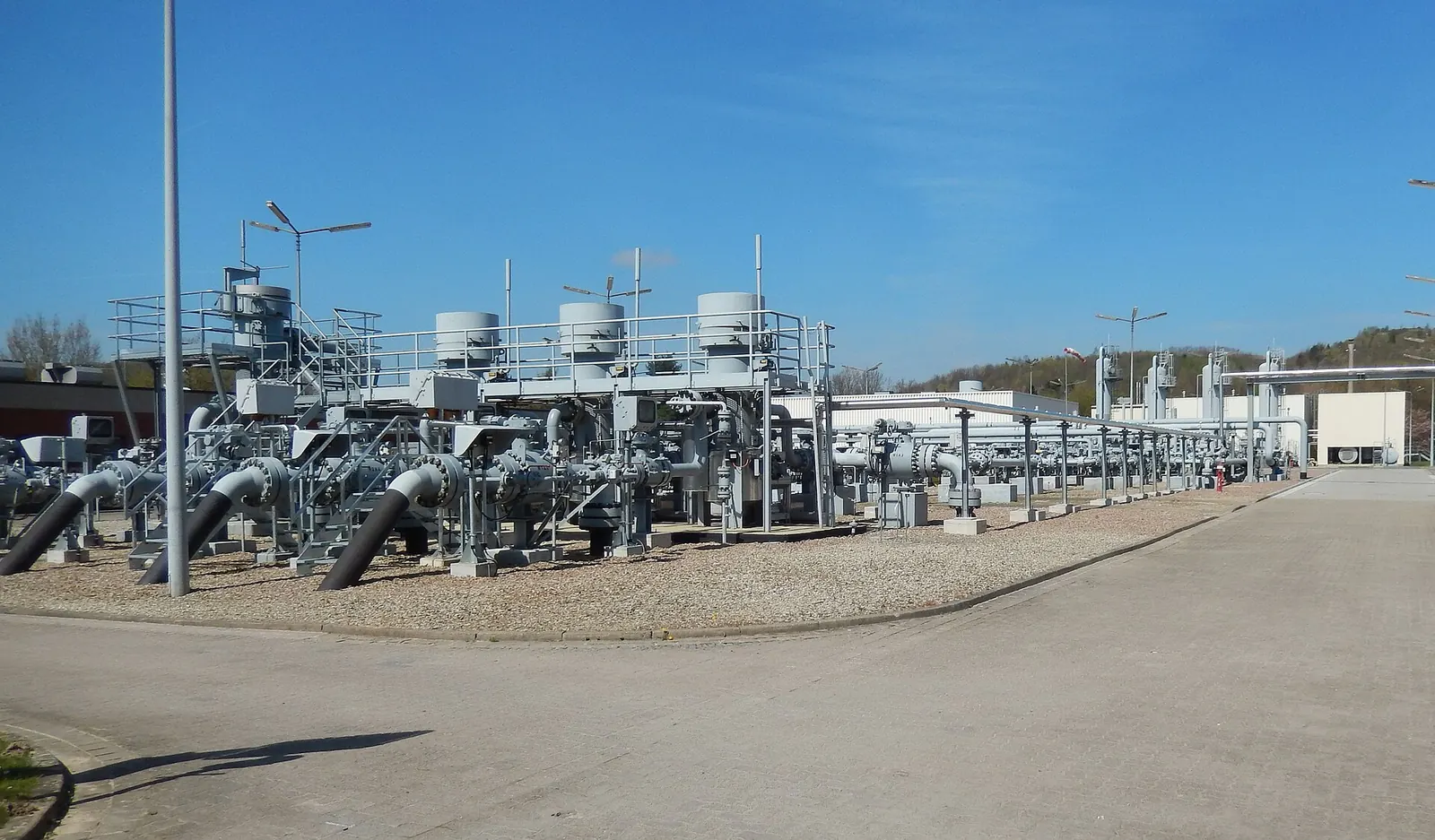
Europe enters the second half of the 2026 injection season with its gas storage further behind than at any point since the 2022 crisis. ENTSOG's Summer Supply Outlook found that EU storage sites were just 28 per cent full on 1 April, about 314 TWh, lower than at the start of the previous three filling seasons and roughly in line with levels seen before 2022. A colder 2025-26 winter drew heavily on stocks after the season began in October 2025 with storage 83 per cent full. ENTSOG estimated that Europe would need around 943 TWh of LNG imports, roughly 86 billion cubic metres, between April and September to reach 90 per cent by the end of the summer, with a further 66 TWh needed if remaining Russian pipeline supplies stopped. By early July, ACER put storage at around 49 per cent, with refill rates trailing both last year and the ten-year average.
The backdrop is the conflict in the Gulf. Damage to part of Qatar's export infrastructure and disruption of shipping through the Strait of Hormuz have tightened global LNG supply. Although only about 8 per cent of Qatar's LNG went to the EU in 2025, the disruption has lifted prices everywhere and narrowed the spread between summer and winter contracts, which reduces the commercial incentive to inject gas into storage. Our view is that Europe faces a price problem, not a security crisis, and that the right response is to use the flexibility already built into the storage rules rather than to chase a 90 per cent target at any cost.
The arithmetic of refilling
ACER has estimated that the EU would need about 13 per cent more LNG imports than in 2025 to reach 90 per cent by 1 November. If member states use the flexibility in the storage regulation and aim for 80 per cent instead, last year's level of LNG imports would be enough. That is the key number in this summer's debate. The difference between 80 and 90 per cent is the difference between needing additional LNG cargoes in a tight global market and being able to manage with the volumes Europe already attracts.
ENTSOG also modelled stress cases. If global LNG supply fell by 20 per cent, European storage would reach only around 76 per cent by the end of September. Combined with a complete halt to remaining Russian pipeline gas, the level would be about 70 per cent. These are serious scenarios, but even they leave Europe with substantial stocks and an import system that has been transformed since 2022.
Why this is not 2022
The European Commission has been careful to stress that the situation bears little resemblance to 2022. Its energy spokesperson, Anna-Kaisa Itkonen, said there were no concerns for security of supply and that the Commission's concern was prices. That is a fair characterisation. In 2022 Europe lost most of its largest supplier's pipeline volumes within months and had limited capacity to replace them. Since then the EU has added significant LNG regasification capacity, including floating terminals in Germany, Italy and elsewhere, and LNG now accounts for around half of EU gas imports. ENTSOG judges that the expanded regasification capacity can partly offset lower stocks.
Demand is also lower. Industrial gas demand fell sharply during the crisis and has not fully recovered, and the growth of renewables has reduced gas burn in power generation in many hours. The system is more flexible, more diversified and less dependent on a single supplier than it was four years ago.
The risk of overreacting
The temptation in a tight market is to push for the highest possible storage level as insurance. But storage targets that force buying in the summer at elevated prices transfer money from European consumers to LNG sellers, and they compete directly with Asian buyers who are also short of Qatari supply. When every buyer tries to fill storage simultaneously, prices rise further and the cost of insurance escalates. The Commission's caution about unsettling the market reflects that concern: panic buying would make the problem worse.
The storage regulation was amended to allow precisely this kind of flexibility, so that member states can deviate from the 90 per cent target when market conditions are unfavourable. Using it is not a sign of weakness. It is a sign that the rules are working as designed.
There is a further reason for restraint. The flatter the spread between summer and winter prices, the less storage operators and traders earn from injecting gas, and the more the burden shifts to governments or regulated entities to fill on their behalf. Mandated filling in a flat curve is a direct cost to consumers. A lower target reduces that cost while keeping enough gas in the ground for a normal winter.
What should be done
Our recommendations are straightforward. Member states should coordinate their storage trajectories, so that buying is spread over the remaining summer and countries do not all seek cargoes in the same weeks. They should aim for a level of around 80 per cent where market conditions justify it, and focus on making sure stored gas is where it is needed, especially in countries with high winter demand and limited import options. They should prepare demand-side measures, including voluntary industrial demand reduction with compensation, which proved effective in 2022 and can be reactivated quickly if a cold winter coincides with further supply disruption.
Europe should also be clear about the limits of what it controls. The trajectory of the Gulf conflict and the restoration of Qatari exports will determine global LNG supply this winter more than any EU policy. European policy can manage how much Europe pays and how resilient it is to a shock, not whether the shock happens.
Our assessment
Europe will enter the winter with less gas in storage than it would like, and prices will remain elevated as long as Gulf exports are disrupted. But the EU has the infrastructure, diversity of supply and regulatory flexibility to manage. The priority should be to avoid turning a price problem into a self-inflicted crisis by chasing a 90 per cent target in a market that cannot easily supply it. A coordinated approach aiming at around 80 per cent, backed by demand-side preparedness, is the sensible path.