
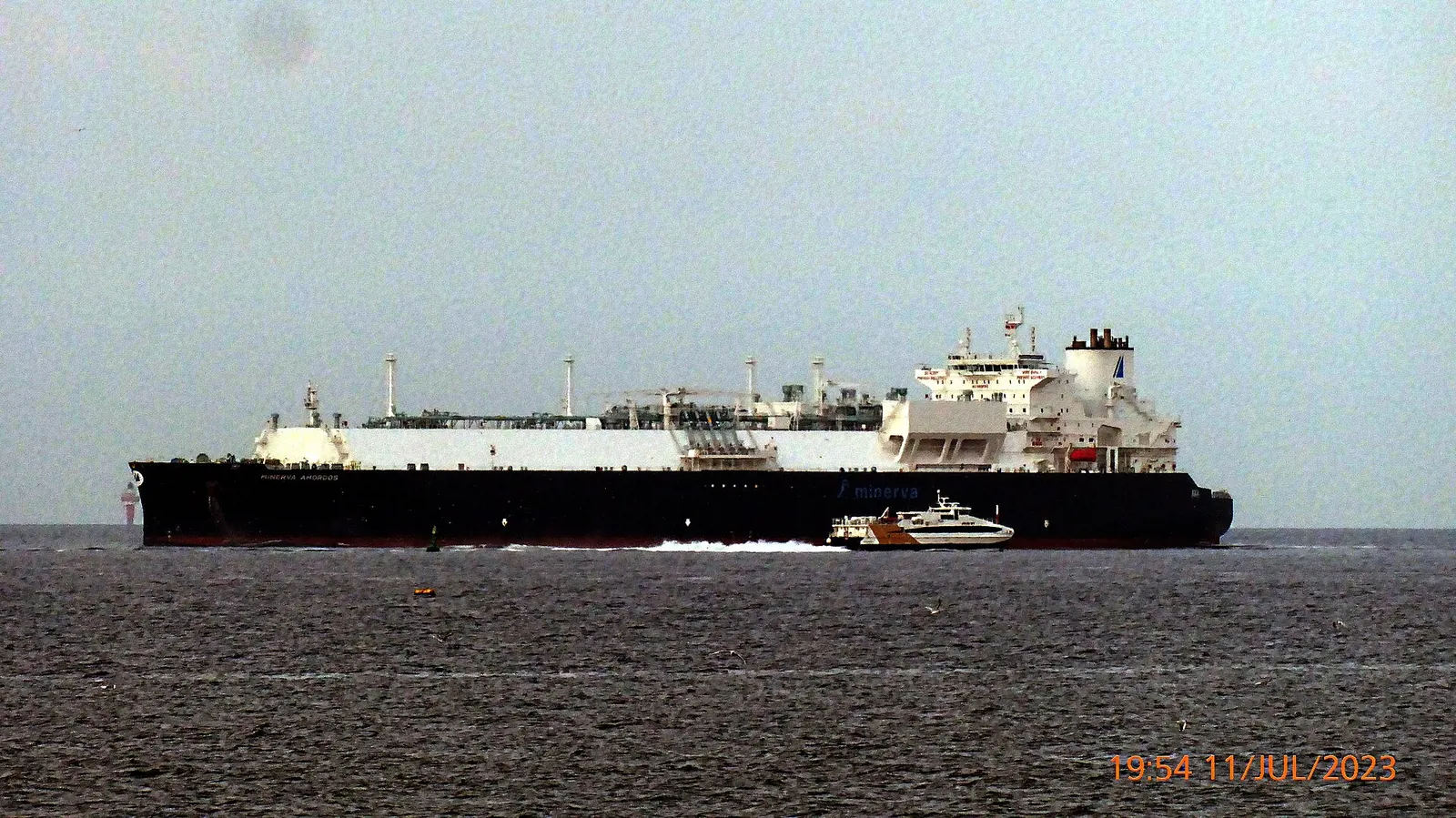
EIA's 16 April 2026 Today in Energy analysis, drawing on the Short-Term Energy Outlook, forecasts that United States net natural gas exports will grow 18 percent to 18.7 billion cubic feet per day in 2026 and another 10 percent to 20.5 billion cubic feet per day in 2027. LNG exports are projected to rise 1.9 billion cubic feet per day in 2026 to average 17.0 billion cubic feet per day, then increase a further 9 percent, or 1.5 billion cubic feet per day, in 2027. Pipeline exports are expected to grow 4 percent (0.4 billion cubic feet per day) in 2026 and 2 percent (0.2) in 2027.
Capacity and projects
Current United States peak export capacity is given as 18.3 billion cubic feet per day. In 2026, Corpus Christi Stage 3 trains 5 to 7 add 0.6 billion cubic feet per day combined and Golden Pass starts its first two trains at 1.4. Port Arthur Phase 1 at 1.6, Rio Grande Trains 1 and 2 at 1.4, and Golden Pass's final train at 0.7 are expected to begin exports the following year. Plaquemines and Elba Island received DOE approvals in March and April 2026 to raise permitted exports by 0.5 and 0.1 billion cubic feet per day respectively.
Destination shifts in 2025
United States LNG to Europe reached a record 10.3 billion cubic feet per day in 2025, up from 6.3 in 2024, and accounted for 68 percent of export volumes. Asia fell from 4.0 to 2.5 billion cubic feet per day, or 16 percent of volumes, with China-bound cargoes falling to zero from 0.6 amid trade tensions. Egypt took 1.2 billion cubic feet per day, up from 0.3. Pipeline exports are projected at 9.8 billion cubic feet per day in 2026 and 10.0 in 2027 after 9.5 in 2025, with Mexico demand a key driver.
Power-market reading
A nearly 30 percent rise in net exports over the forecast window intensifies the need for winter deliverability analysis in power markets. Storage can be comfortable nationally, as other STEO releases show, while basis still blows out on constrained laterals. Generators should treat LNG ramp schedules as visible competitors for molecules. Policymakers should keep public-interest analysis honest about domestic incidence even while celebrating export growth.
The United States is not dabbling in LNG. It is scaling a permanent export industry that reshapes Atlantic and Pacific trade and domestic gas-electric coupling at once.
The practical discipline is unchanged across fuel types and market constructs. Read the primary docket or statistical release before arguing about national destiny. Separate nameplate megawatts from accredited capacity, and contracted offtake from commissioned trains. Map interconnection and transmission lead times onto customer energisation promises rather than the other way round. Treat winter and summer extreme cases as design conditions. When federal policy shifts, update the slope of the forecast without rewriting physical laws. When state commissions push back on cost allocation, treat that push-back as part of the build path rather than as noise. United States energy infrastructure is financed, permitted and operated by people who must reconcile those constraints daily. Analysis that ignores them will not survive first contact with a peak day. Regional operators will continue to publish winter assessments, summer reliability outlooks and interconnection status reports. Those documents, read together with EIA inventories and FERC orders, give a clearer picture than any single speech. Investors should price execution risk honestly. Policymakers should resist the urge to treat one statute or one survey table as the whole system. The grid is a machine. Machines care about margins, not metaphors.