
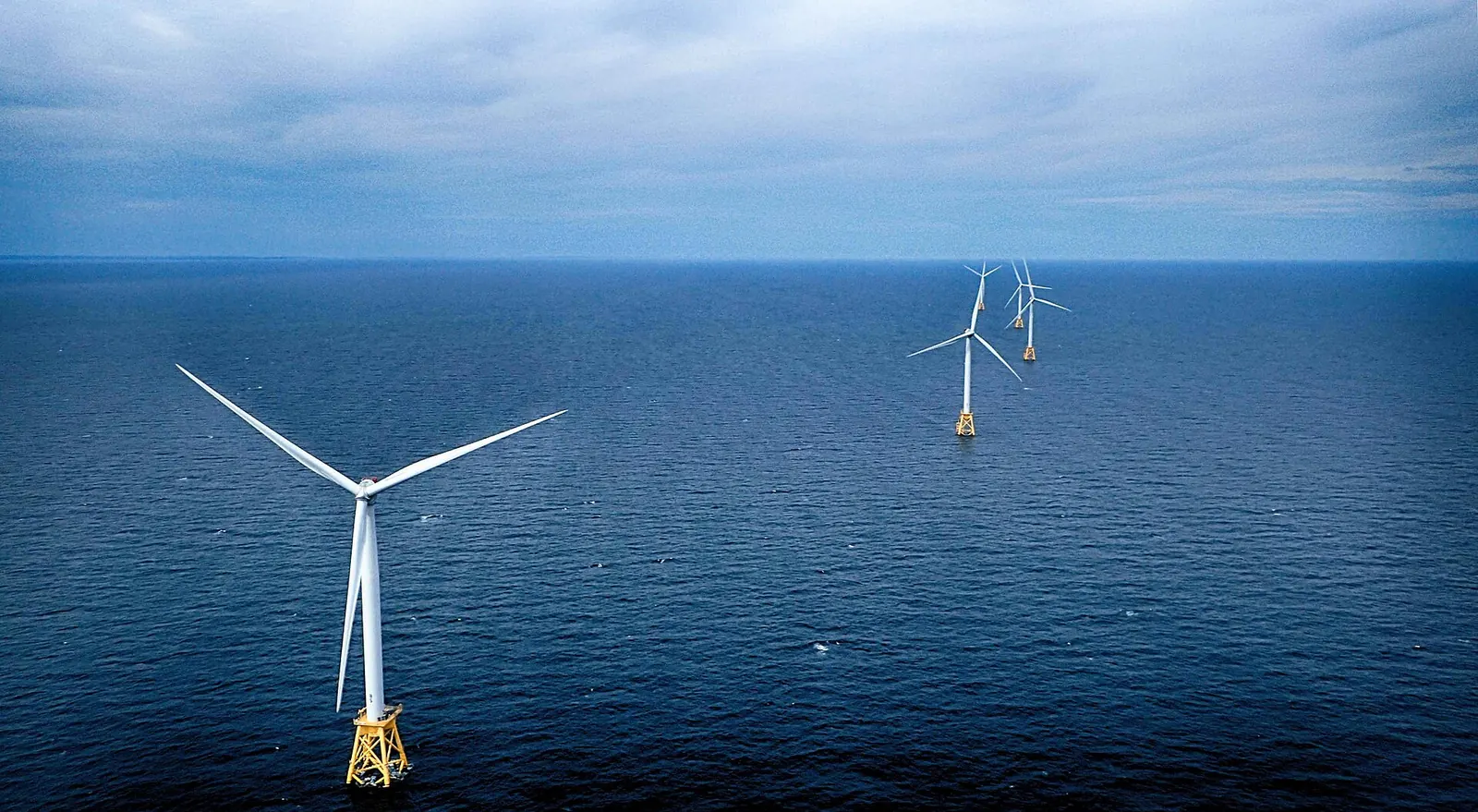
On September 18, 2026, the developers of Revolution Wind confirmed that the 65th and final turbine had been installed at the project, about 15 miles south of the Rhode Island coast. The 704-megawatt wind farm, a 50/50 joint venture between Ørsted and Skyborn Renewables, a Global Infrastructure Partners company, has been delivering power to Rhode Island and Connecticut at partial output since March and is expected to reach full capacity later this year. Canary Media puts the project's cost at USD 6.2 billion. It will sell power under fixed-price, 20-year contracts with utilities in the two states and, according to Ørsted, supply more than 350,000 homes and businesses.
The completion is a significant achievement given the obstacles. The Interior Department's Bureau of Ocean Energy Management issued a stop-work order against Revolution Wind on August 22, 2025, citing unspecified national security concerns, when the project was about 80 percent complete. A federal judge lifted that order a month later. In late December 2025 the administration issued new stop-work orders against all five offshore wind projects then under construction, which courts struck down one by one from January. Our view is that the projects now reaching completion show that offshore wind can deliver valuable winter power for the Northeast, but that federal policy has inflicted lasting damage on the pipeline. The question for New England and New York is no longer how to reach their original targets, but how to replace the capacity that will not now be built.
The court fight
When Judge Royce Lamberth of the US District Court for the District of Columbia granted Revolution Wind a preliminary injunction on September 22, 2025, he found that the developers faced irreparable harm. The Associated Press reported that the judge cited delays costing USD 2.3 million a day and the risk that the entire project could collapse if deadlines were missed, because the specialized installation vessel would not be available again until at least 2028. In his written ruling, he said Revolution Wind had demonstrated a likelihood of success on the merits.
The administration argued in court that BOEM's approval had required the developer to continue working with the Defense Department on national security issues, and that those concerns had not been resolved. Connecticut Representative Joe Courtney, among others, responded that the project had been fully permitted with input from the Pentagon. The courts' repeated rejection of the stop-work orders suggests that, at least for projects with final approvals, the legal protections for permitted infrastructure are robust. That is important for investors in all types of energy projects, not just wind.
The value of the power
Offshore wind's main value to New England is its winter performance. The region's grid is constrained by limited natural gas pipeline capacity, and in cold snaps gas is diverted to heating, forcing power plants to burn oil or import LNG at high prices. Canary Media reports that Vineyard Wind 1 performed strongly during Winter Storm Fern earlier this year, even before full operation, and that output from Vineyard Wind 1 and Revolution Wind reduced reliance on oil-fired peaking plants during the July heat wave.
Connecticut's Department of Energy and Environmental Protection estimated, according to Ørsted, that Revolution Wind could save New England ratepayers up to USD 500 million a year in wholesale energy costs once fully operational. Even if that estimate proves optimistic, the fixed-price contracts provide a hedge against volatile gas prices, which have been sharply higher this year because of the disruption to global LNG markets.
The damage to the pipeline
The broader picture is bleak. Canary Media cites BloombergNEF's estimate that, when President Trump was elected in November 2024, the United States was expected to build 39 gigawatts of offshore wind by 2035. By the end of 2025, that figure had been cut to just 6 gigawatts, essentially the five projects already under construction. Besides Revolution Wind, South Fork Wind and Vineyard Wind 1 are complete, Coastal Virginia Offshore Wind began delivering power in March and should finish construction next year, and Empire Wind and Sunrise Wind are expected to be fully operational in 2027.
The administration has moved from trying to stop projects to offering refunds to developers that give up their offshore leases, with nearly USD 4 billion committed so far, according to Canary Media. Combined with the end of federal tax credits for wind projects that do not start construction by July 2026, this effectively halts new US offshore wind development for the foreseeable future. Ørsted itself has been weakened by write-downs and has refocused on Europe.
Lessons for investors
For infrastructure investors generally, the Revolution Wind episode carries two lessons. The first is that a final federal permit is a strong legal asset: courts were unwilling to let an agency halt a fully permitted project without a reasoned basis. The second is that political risk can still impose heavy costs even when the law is on the developer's side. Weeks of delay, legal fees and the uncertainty of litigation all add to project costs, and investors will price that risk into future US energy projects that depend on federal goodwill.
What the Northeast should do
The states face a gap. Their decarbonization and resource plans assumed several gigawatts of offshore wind in the early 2030s, and electricity demand is now rising. Options include expanding transmission links to Canadian hydropower and to inland wind and solar, accelerating battery storage to manage peaks, extending the life of existing nuclear plants and, in the near term, keeping some gas and oil-fired capacity available for winter reliability. Large buyers in the region should expect tighter supply and higher prices in winter.
The states should also preserve what they can of the offshore wind supply chain, including port investments and vessel contracts, so that development can resume if federal policy changes. Ørsted says it is investing nearly USD 700 million in US shipbuilding and vessel contracts across its projects. Losing that capability would make any future revival slower and more expensive.
Our assessment
Revolution Wind's completion shows that offshore wind can be built in the United States and that it delivers valuable power when the Northeast needs it most. The courts protected projects that had received final permits, an important principle for all infrastructure investors. But the federal campaign against the industry has achieved its broader aim: beyond the five projects now finishing, there is no meaningful pipeline. The Northeast needs a realistic plan to meet rising winter demand without the offshore wind capacity it had counted on.