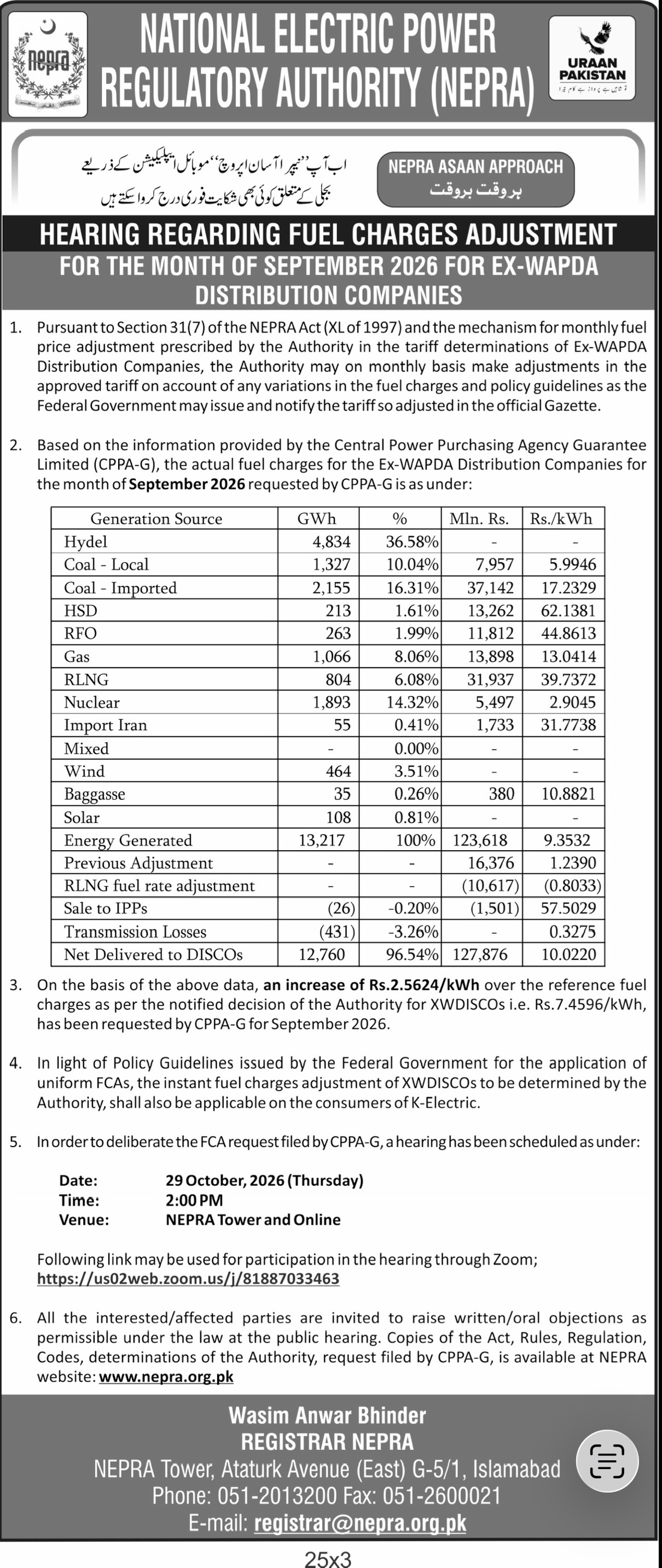
The Central Power Purchasing Agency (Guarantee) Limited (CPPA-G) sent NEPRA its energy purchase data for September 2026 on 15 October, and the regulator will hear the resulting fuel charges adjustment (FCA) request on 29 October. The headline is a claim of Rs2.5624 per kWh for consumers of the ex-WAPDA distribution companies: actual fuel cost of Rs10.0220 per unit delivered against a reference of Rs7.4596. Under federal policy the figure NEPRA decides will also apply to K-Electric consumers. On the 12,760 GWh delivered to the distribution companies, the request is worth about Rs32.7 billion.
The TEI news brief of 21 October set out those totals. This piece works through the plant-level tables in the same CPPA-G filing to see where the money went. All of the calculations below use the provisional figures in that document; NEPRA can and often does revise them at the hearing.
A small share of the energy, a large share of the cost
Plants in the CPPA-G tables generated 13,217 GWh in September and billed Rs123.62 billion in current-month fuel charges. That is an average of Rs9.35 per unit generated.
Hydropower supplied 4,834 GWh, or 36.6% of the total, with no fuel charge. Wind added 464 GWh and solar 108 GWh. Together the three supplied 40.9% of September's energy and none of its fuel cost. Nuclear supplied another 14.3% at Rs2.90 per unit. Local coal from Thar supplied 10.0% at Rs5.99.
At the other end of the merit order, three fuels did something quite different. By TEI's calculation from the summary table:
- RLNG: 803.7 GWh (6.1% of generation) at Rs39.74 per unit, Rs31.94 billion (25.8% of fuel charges)
- Furnace oil (RFO): 263.3 GWh (2.0%) at Rs44.86 per unit, Rs11.81 billion (9.6%)
- High-speed diesel (HSD): 213.4 GWh (1.6%) at Rs62.14 per unit, Rs13.26 billion (10.7%)
Combined, the three generated 1,280 GWh, or 9.7% of the month's power, and accounted for Rs57.01 billion, or 46.1% of the fuel bill. The two oil products alone supplied 3.6% of the energy and 20.3% of the cost. Imported coal was the other large item, with 2,155 GWh at Rs17.23 per unit and Rs37.14 billion, about 30% of the total. Domestic pipeline gas supplied 1,066 GWh at Rs13.04.
A unit from diesel cost about 21 times a unit from nuclear in September and about ten times a unit from Thar coal. Every hundred GWh moved from RLNG or oil to the cheaper plants changes the monthly bill by billions of rupees, which is why the dispatch of a small number of plants matters so much for the FCA.
Diesel at the RLNG plants
The plant rows show where the diesel was burned. Nearly all of the 213.4 GWh of HSD generation came from four large combined-cycle plants that were built to run on RLNG: the two plants of National Power Parks Management Company (Haveli Bahadur Shah and Balloki), Quaid-e-Azam Thermal Power at Bhikki, and Punjab Thermal Power at Trimmu. The energy purchase table attributes 71.9 GWh of diesel generation to Quaid-e-Azam Thermal, 53.7 GWh to Haveli Bahadur Shah, 49.1 GWh to Punjab Thermal and 38.3 GWh to Balloki. Three smaller plants, Orient, Saif and Halmore, account for the remaining 0.5 GWh. The four rows sum to the HSD total in the summary table.
At Haveli Bahadur Shah and at Punjab Thermal, the diesel output was larger than the RLNG output. The breakup of fuel charges lists 531.6 GWh of RLNG generation for the two National Power Parks plants combined, of which the energy table puts 29.9 GWh at Haveli and 501.7 GWh at Balloki. Punjab Thermal produced 30.7 GWh on RLNG against 49.1 GWh on diesel.
The Power Division said in a statement reported by Business Recorder that the September adjustment could have reached Rs5 to Rs6 per unit because of heavier use of furnace oil and diesel, and that it used targeted load management of about two to two and a half hours in September to limit that use. The same statement said Pakistan was meeting its RLNG needs from contracted supply and spot cargoes after Qatar's declaration of force majeure, and that any further cut in RLNG would mean more oil-fired generation. TEI's 6 October research on the LNG book and the 3 October piece on furnace oil cover the supply side.
The part-load charge
Combined-cycle plants that run below their rated output burn more fuel per unit, and their tariffs allow for this through a load correction factor. The CPPA-G breakup of fuel charges claimed by IPPs shows how large the allowance was in September. For the ten IPPs listed, NEPRA-approved fuel cost at the reference rates was Rs37.75 billion. On top of that sat Rs1.03 billion for heat-rate degradation and Rs4.02 billion of part-load correction, for total fuel charges of Rs42.80 billion on 1,369 GWh.
Most of the part-load money went to the RLNG plants. TEI's calculations from the breakup, using 720 hours in September and the dependable capacities in the table:
- National Power Parks (2,317 MW): RLNG output equal to a 31.9% load factor, part-load charge Rs2.91 billion, or Rs5.47 per RLNG unit and 13.2% of its RLNG fuel charges
- Quaid-e-Azam Thermal (1,109 MW): 28.7% load factor on RLNG, Rs0.51 billion, or Rs2.21 per unit
- Punjab Thermal (1,244 MW): 3.4% load factor on RLNG, Rs0.25 billion, or Rs8.07 per unit and 20.8% of its RLNG fuel charges
These load factors count RLNG output only. Adding the diesel rows raises them, to about 37% for National Power Parks, 38% for Quaid-e-Azam Thermal and 9% for Punjab Thermal. Plants running for a few hours a day, or cycling around the evening peak, are paid for the extra fuel that operation burns. The September figures put that cost at roughly Rs4 billion for the month, about Rs0.31 per unit delivered.
Previous adjustments and the gas-rate relief
Two items below the generation total change the result substantially, in opposite directions.
The first is Rs16.38 billion of previous-period fuel cost adjustments, which CPPA-G adds to September's bill. That equals about Rs1.28 per unit delivered. Most of it sits on one line. Thar Coal Block-1 Power Generation Company, the 1,213 MW plant in Tharparkar, shows current-month fuel charges of Rs2.92 billion and a previous-period fuel adjustment of Rs10.27 billion. That single adjustment is 63% of all prior-period charges and works out to about Rs0.80 per unit delivered. The filing does not explain the line. RLNG plants added Rs3.45 billion of prior adjustments and imported coal Rs2.31 billion.
The second is a deduction of Rs10.62 billion, labelled in the summary as a provision for a reduced gas rate for RLNG on account of system gas. The Power Division described this as imported LNG supplied to the power sector at domestic gas rates, and put the benefit at 83 paisa per unit. TEI's calculation from the filing gives Rs0.832 per unit delivered, which matches.
Holding everything else equal, the request would have been about Rs3.39 per unit without the gas-rate deduction. If both the previous adjustments and the deduction are taken out, leaving only September's own fuel cost and the Rs1.50 billion that CPPA-G marks as not chargeable to the distribution companies, the figure is about Rs2.11. In other words, September's own fuel costs ran about Rs2.1 above the reference, and the prior-period charges more than offset the subsidy on RLNG.
What NEPRA will look at
NEPRA's monthly decisions usually test whether the system operator followed economic merit order and whether any deviation from it was justified by transmission constraints or fuel availability. The September filing gives the hearing several things to look at: diesel use at plants designed for RLNG, the part-load allowances at those same plants, and a single Rs10.27 billion prior adjustment for a Thar coal plant. The Authority can disallow costs it finds were caused by non-economic dispatch.
There is also the matter of trend. The Power Division's statement put September's figure Rs1.45 per unit above the August adjustment, which implies about Rs1.11 for August. The reference fuel cost for each month comes from NEPRA's tariff determination for FY2026-27. A positive FCA means the month's actual mix and fuel prices cost more than that determination assumed. The CPPA-G filing does not restate the reference mix, so the tables alone cannot say how much of the Rs2.1 gap in September's own fuel cost came from each fuel.
Losses also enter the per-unit figure. Generation of 13,217 GWh became 12,760 GWh delivered to the distribution companies, a difference of 457 GWh, or 3.5%, which covers transmission losses and sales to IPPs listed in the filing. The fuel cost of those units is spread over the delivered volume, so it raises the per-unit rate on what consumers buy.
The calculations for this piece are in TEI's working file for the September 2026 FCA, built directly from CPPA-G's summary and breakup tables. NEPRA's decision after the 29 October hearing will be published on its website as a notified determination.