
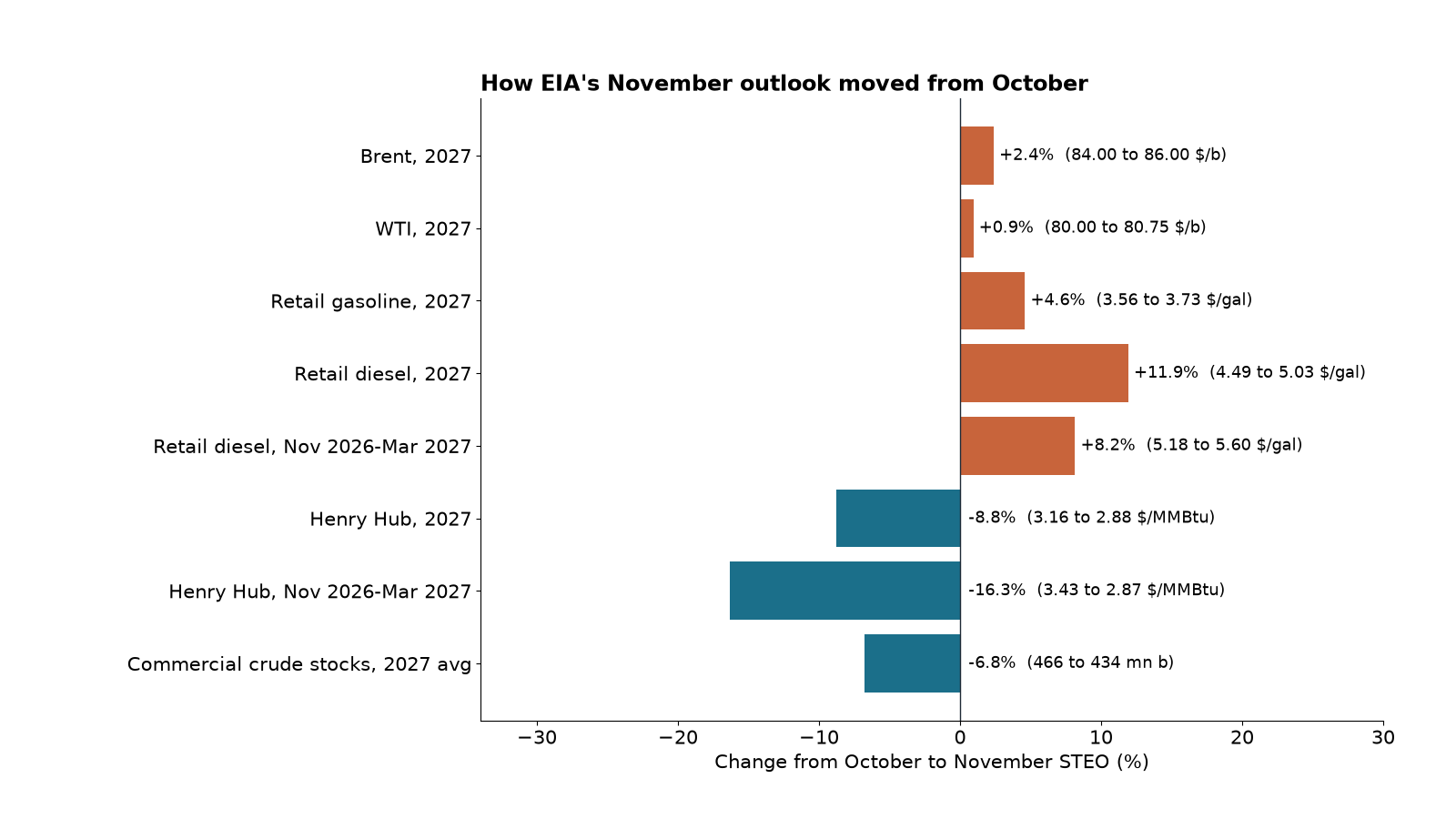
The US Energy Information Administration's November Short-Term Energy Outlook moved its forecasts for oil products and natural gas in opposite directions. EIA raised its 2027 retail diesel and gasoline prices and lowered its Henry Hub gas price, while leaving its crude price path only slightly higher. We compared the November and October data files series by series to measure the size of each change.
Annual averages below are means of EIA's monthly values unless stated, and winter means November 2026 to March 2027.
Oil: crude edges up, products jump
EIA's Brent forecast for 2027 rose from $84 to $86 a barrel, or 2.4%. Its 2026 average moved from $96.1 to $97.2. The path still falls steeply through next year: EIA expects Brent near $100 for the rest of 2026, below $90 in the second quarter of 2027 and an average of $77 in the fourth quarter. WTI for 2027 moved less, from $80.00 to $80.75.
The context is a market still recovering from the Strait of Hormuz disruption. Brent averaged $124 in October, the highest since July 2022 in inflation-adjusted terms, before dropping below $100 on 4 November. EIA estimates Middle East production shut-ins averaged 2.5 million barrels a day in October, down from a 10.9 million peak in May, and expects global inventories, which fell by 1.2 million b/d in the third quarter, to build by 3.5 million b/d in the first half of 2027.
Products moved much more than crude. Retail diesel for 2027 rose from $4.49 to $5.03 a gallon, an increase of 11.9% in the monthly data and the 12% EIA cites. Diesel over the coming winter rose from $5.18 to $5.60. Retail gasoline for 2027 rose 4.6%, from $3.56 to $3.73.
EIA's explanation is that it now assumes global product markets stay constrained through the end of 2027. Damage to refineries in the Middle East and Russia has cut product exports available to world markets, and EIA expects US crack spreads to stay elevated through most of next year, with disruptions concentrated in the first quarter.
A wider margin between crude and the pump
One way to see the shift is to set retail prices against crude. Converting Brent to cents per gallon at 42 gallons a barrel, we calculate that the 2027 gap between retail diesel and Brent widens from about $2.49 a gallon in the October outlook to $2.98 in November, an increase of about 49 cents. The equivalent gasoline gap rises from about $1.56 to $1.68.
These spreads include taxes, distribution and retail margins as well as refining, so they are a broad measure. The direction is still clear. Nearly all the change in EIA's 2027 diesel forecast comes from the product side, with crude contributing about 5 cents of the 54-cent increase.
For diesel-intensive sectors such as road freight and farming, that matters more than the headline crude path. A falling Brent price through 2027 would leave diesel costs elevated if the product market stays tight.
A wider Brent-WTI spread
The crude revisions were not uniform. Because EIA raised Brent more than WTI, the 2027 spread between them widens by our calculation from $4.00 to $5.25 a barrel. For the coming winter, Brent is unchanged at $97.60 while WTI was cut from $92.80 to $91.20, widening the spread from $4.80 to $6.40. EIA links the wide spread to tight tanker markets, and it is the mechanism behind the fall in US crude stocks: a wide spread makes US crude exports attractive and imports less so.
Crude stocks lower, production higher
EIA also lowered its path for US commercial crude inventories. The 2027 average fell from about 466 million barrels to 434 million, a cut of 6.8%. Stocks ended October at 410 million barrels, the lowest end-of-October level since 2014, as a wide Brent-WTI spread drew crude into exports and away from imports, and refiners ran hard.
EIA expects stocks to stay below the five-year average through the middle of next year and then rise, from 416 million barrels at the end of January 2027 to 444 million at the end of December. It forecasts record crude production of 14.3 million b/d in 2027, up from 13.9 million in 2026, with refinery inputs easing from 16.7 million b/d to 16.5 million.
Gas: a mild November changes the winter
The gas revisions run the other way. EIA lowered its Henry Hub forecast for November to March from $3.43 to $2.87 per MMBtu, a 16.3% cut, and its 2027 average from $3.16 to $2.88. The winter forecast is now 36% below last winter's price. EIA's 2026 average is $3.37.
The main reason is weather. EIA assumes 13% fewer heating degree days than the ten-year average for November and now expects 3,840 Bcf in storage at the end of the month, 67 Bcf more than it forecast in October. Production growth is expected to outpace domestic and export demand next year, leaving inventories about 3% above 2026 levels on average.
International gas prices, meanwhile, are at their highest since December 2022, and US LNG export terminals are running near capacity. In our reading, that combination helps keep US gas cheap relative to oil, because terminals already running near capacity cannot send much more gas abroad to capture the international premium.
Oil's premium over gas
Putting both fuels on an energy basis shows how far the two forecasts have drifted apart. Using 5.8 MMBtu per barrel of crude, we calculate that 2027 Brent in the November outlook is equivalent to about $14.8 per MMBtu, or 5.1 times the Henry Hub forecast. In October the ratio was about 4.6. For the coming winter the ratio rises from about 4.9 to 5.9.
A ratio of that size favours gas wherever fuel switching is possible, notably in power generation and industrial heat. It also supports the economics of LNG exports, which EIA expects to reach 19 Bcf/d in 2027.
What moved little
Several series barely changed. EIA's 2027 residential electricity price and its battery and coal capacity paths were close to October's values, and we have covered those separately. The revisions in this outlook are concentrated in fuel prices, and specifically in the gap between refined products and natural gas.
Reading the revisions
EIA cautions that Middle East flows, through Hormuz and alternative routes, remain vulnerable to disruption, and that short-term price swings are likely to be larger than its monthly path shows. The diesel revision in particular rests on an assumption about product markets through all of 2027, which is a long horizon for a market that moved this much within one month. The gas revision rests mostly on November weather and could reverse with a cold December.
Taken together, the November outlook describes a year in which US consumers face high prices for liquid fuels and low prices for gas. Investment choices that depend on the relative cost of the two, such as converting vehicle fleets or choosing a heating fuel, will be sensitive to how long that gap persists.