
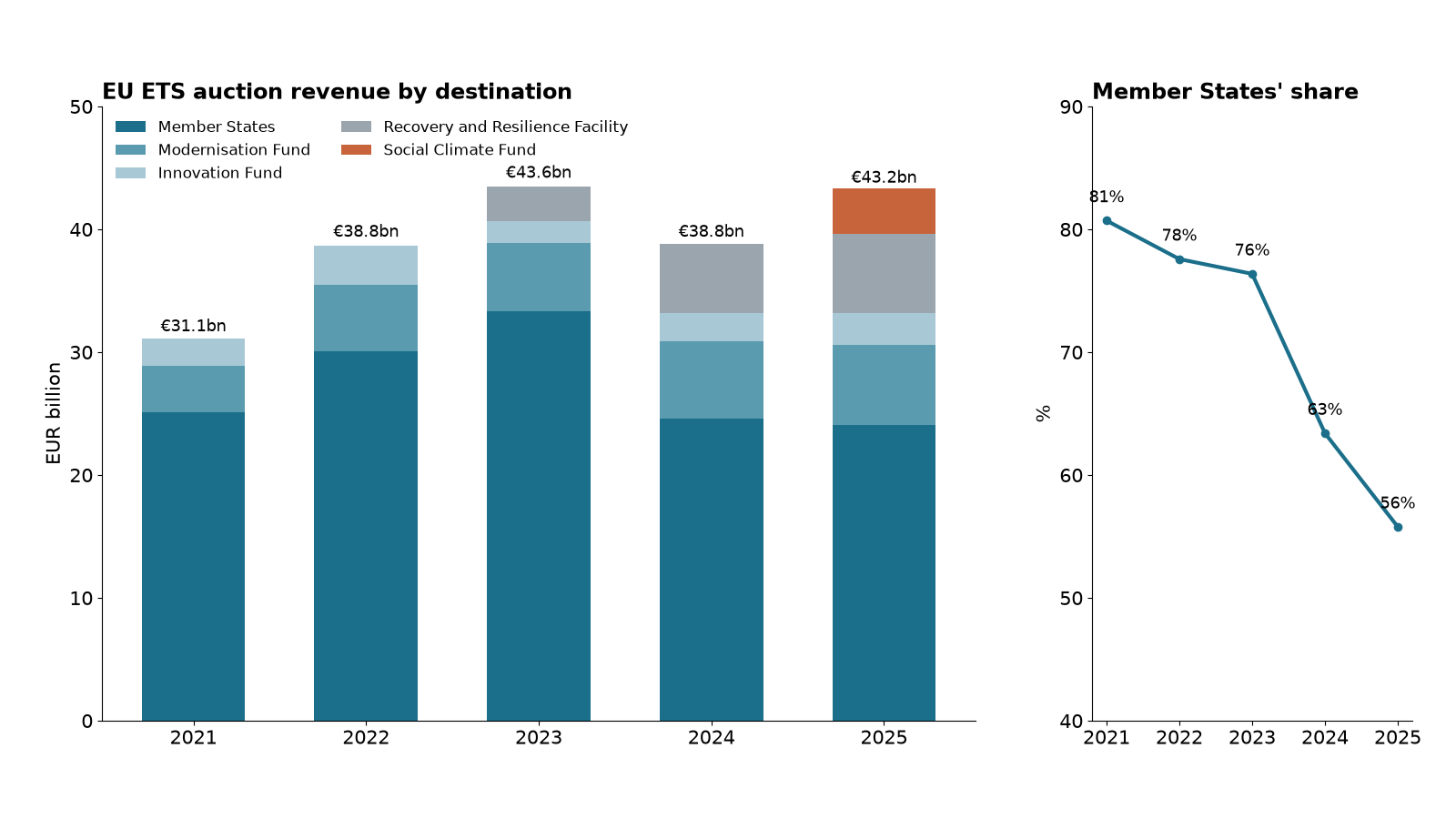
The European Commission's 2026 Carbon Market Report, published on 9 November, reports EU Emissions Trading System auction revenue of €43.2 billion in 2025, up 11% from 2024 and close to the 2023 peak of €43.6 billion. The headline is steady. The composition underneath it has changed considerably since the start of Phase 4.
Where the money went
Table 3 of the report breaks revenue down by destination. In 2021, €25.1 billion of €31.1 billion went to member state budgets, with the rest to the Innovation Fund and Modernisation Fund. In 2025, member states and EEA-EFTA states received €24.1 billion of €43.2 billion. The Modernisation Fund took €6.5 billion, the Innovation Fund €2.6 billion, the Recovery and Resilience Facility €6.4 billion and the new Social Climate Fund €3.7 billion.
By our calculation, the direct national share fell from 81% in 2021 to 78% in 2022, 76% in 2023, 63% in 2024 and 56% in 2025. Two changes explain most of the drop. From July 2023, allowances were diverted to the Recovery and Resilience Facility to raise €20 billion for REPowerEU, a target reached in July 2026 after 278.5 million allowances were auctioned. And from 2025, 50 million allowances a year go to the Social Climate Fund.
The revenue figures and the report's summary differ slightly. The summary says €23.9 billion went directly to EU member states, while Table 3 gives €24.1 billion for member states and EEA-EFTA states together. We use Table 3 for the time series because it is consistent across years.
A higher price on fewer allowances
The average auction price in 2025 was €73.43, up from €64.74 in 2024, within a range of €59.76 on 7 April to €84.60 on 15 December. Auction volumes slipped from 599.5 million allowances in 2024 to 588.7 million. Dividing revenue by volume gives about €73.4 per allowance, consistent with the reported average. In the first half of 2026, prices ranged from €62.19 to €91.34.
The price and the volume pull in different directions over the next year. The Market Stability Reserve will withhold 190 million allowances from auction between September 2026 and August 2027, after the surplus in circulation stood at 1,023 million at the end of 2025. Unless prices rise to compensate, that points to lower auction revenue in 2027.
How national revenue was spent
Member states must report how they use their share. Of the €23.9 billion collected by EU member states in 2025, Italy and Cyprus, which together received €2.7 billion, had not yet reported. Of the €21.1 billion reported, €5.1 billion, or 24%, financed aid to electricity-intensive industries for indirect carbon costs. The remaining €16.0 billion falls under the obligation to spend on climate and energy purposes, and member states disbursed €13.5 billion of it in 2025 and committed €0.4 billion.
By our calculation, the disbursed amount equals 56% of the €23.9 billion collected. Of the €13.5 billion, €5.4 billion went to renewables, grids and storage, €2.5 billion to public transport and mobility and €1.5 billion to energy efficiency and heating in buildings.
The indirect cost share is notable. A quarter of reported national revenue went to compensation for carbon costs embedded in power prices, which supports the system's carbon leakage protections and is counted outside the climate and energy spending obligation.
Emissions against the cap
Emissions covered by the system fell about 2% in 2025, to 1,163 million tonnes across stationary installations, aviation and shipping. Power and industry emitted 1,013 Mt, with power down 1.7% and industry down 3.3%. Shipping reported 87.4 Mt and aviation 62.7 Mt. Renewables supplied 47.2% of EU electricity, but gas-fired generation rose 9% as hydropower fell 12% and wind output fell 2%.
The cap is tightening faster than emissions. Allowances issued for power, industry and shipping were 1,298.1 million in 2025 and are set at 1,185.4 million in 2026 and 1,099.3 million in 2027, reflecting a linear reduction factor of 4.3% a year to 2027 and a rebasing cut of 27 million allowances in 2026.
By our calculation, 2025 emissions in that scope, stationary installations plus shipping, were about 1,100.4 Mt, roughly 198 million below the 2025 cap. The 2027 cap is already about 1 million allowances below that 2025 level. If emissions kept falling at 2025's 2% rate, they would be about 1,057 Mt in 2027, leaving a margin of only about 42 million allowances. The banked surplus in circulation softens the effect of any single year's balance. Even so, the margin between annual issuance and annual emissions is closing.
Demand within the same cap will also rise from shipping. Companies surrendered allowances for 70% of 2025 emissions, an obligation of 60.8 million allowances after deductions, and the phase-in reaches 100% for 2026 emissions, when methane and nitrous oxide are also covered. The 2026 cap was raised by about 2.4 million allowances to reflect the wider gas coverage, which is small next to the step up in the surrender share.
Aviation runs on a separate, smaller cap. Its 2025 allocation of 26.2 million allowances compares with 62.7 Mt of emissions, a ratio of about 2.4, because airlines can surrender general allowances.
Revenue per allowance across channels
The different channels raised similar amounts per allowance. By our calculation, the Recovery and Resilience Facility sales raised about €71.8 per allowance on average, €20 billion from 278.5 million allowances over three years. The Social Climate Fund's first 50 million allowances raised €3.7 billion, or about €74 each. In the first half of 2026, total revenue of €18.4 billion from 243.8 million allowances auctioned works out at about €75.5 per allowance, slightly above the 2025 average.
Cumulatively, the system raised €213.8 billion between January 2021 and June 2026. Member states received €145.7 billion of that, 68% by our calculation. The Modernisation Fund received €30.6 billion and the Innovation Fund €13.4 billion. The Recovery and Resilience Facility took €19.8 billion and the Social Climate Fund €4.3 billion so far.
The Modernisation Fund's share matters for the distribution of revenue across countries, because it supports 13 member states, mostly in Central and Eastern Europe, together with Greece and Portugal. Its annual take has risen every year of Phase 4, from €3.8 billion in 2021 to €6.5 billion in 2025.
Free allocation and compliance
Free allocation to stationary installations totalled 480.6 million allowances in 2025, down from 546.1 million in 2021. Adjustments for changes in production and other corrections cut 2021 to 2025 free allocation by 188.7 million below the initial 2,791.1 million. Compliance with monitoring, reporting and surrender obligations was 99.5%.
What to watch
The Commission proposed a reform of the system for 2030 to 2040 in July 2026, and in April it proposed ending the invalidation of allowances held in the reserve above 400 million. Both will shape the supply side. On revenue, the end of REPowerEU sales and the growing Social Climate Fund will keep moving money away from national budgets toward EU-level funds, so the direct national share is likely to stay well below its 2021 level.