
ERCOT has published the first results of a request for information sent to data centre and other large load developers about their sites, equipment and community effects. The preliminary summary, presented at the Public Utility Commission of Texas open meeting on 5 November and filed in Project 59142, is marked subject to change. A final report is targeted for 10 December.
The dataset is the most detailed public view yet of the queue of large computing loads in Texas. It describes size, location, function and how far projects have progressed, and the answers to individual questions show where developers are still undecided.
Who answered
ERCOT sent the RFI to 465 loads. By the time of the summary, 433 (93%) had responded, covering about 177 GW of requested interconnection capacity, or 97% of the total requested by the loads surveyed. Of those, 417 responded on time, most by 5pm Central on 12 October, and 16 late. All 245 large loads, defined as 75 MW or more, responded. The 32 missing responses are all from medium loads below 75 MW.
The reviewed dataset used in the charts contains 429 loads, 243 large and 186 medium, with 177.4 GW of requested peak capacity. Large loads account for about 166 GW, or 94%.
Capacity is concentrated in a few sites
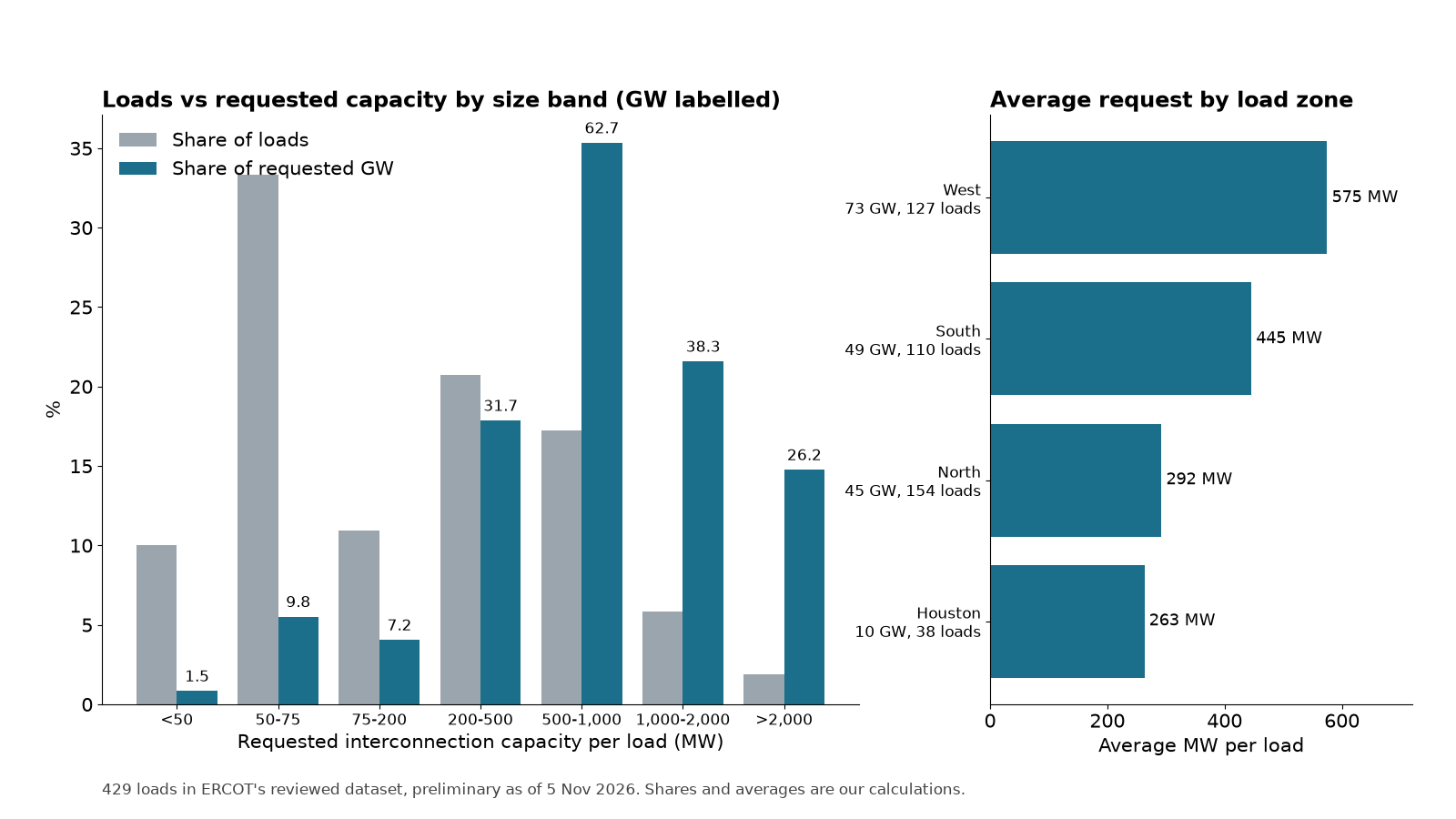
ERCOT groups respondents into seven size bands. Combining its counts and capacity totals, we calculate the share of loads and of capacity in each:
- Under 50 MW: 43 loads (10%), 1.5 GW (1%)
- 50 to 75 MW: 143 loads (33%), 9.8 GW (6%)
- 75 to 200 MW: 47 loads (11%), 7.2 GW (4%)
- 200 to 500 MW: 89 loads (21%), 31.7 GW (18%)
- 500 to 1,000 MW: 74 loads (17%), 62.7 GW (35%)
- 1,000 to 2,000 MW: 25 loads (6%), 38.3 GW (22%)
- Over 2,000 MW: 8 loads (2%), 26.2 GW (15%)
The 33 projects above 1 GW represent about 8% of respondents and 64.5 GW, or 36% of requested capacity. By our calculation they average about 1.95 GW each, and the eight largest average about 3.3 GW. Loads of 500 MW or more make up 25% of respondents but about 72% of capacity.
The medium-load end is crowded just below the threshold. The 50 to 75 MW band is the most populous of all, and ERCOT says more than 85% of the roughly 11 GW of medium-load capacity sits above 50 MW. That pattern bears on the separate medium-load RFI ERCOT has sent to utilities and on how a 75 MW large-load definition shapes project design.
West Texas has the largest sites
ERCOT maps 429 loads to four major load zones using GPS coordinates. West has 127 loads and 73 GW, South 110 loads and 49 GW, North 154 loads and 45 GW, and Houston 38 loads and 10 GW. ERCOT notes that 37 sites lie near zone boundaries and that the assigned zone is set at interconnection.
Dividing capacity by count, the average request is about 575 MW in West, 445 MW in South, 292 MW in North and 263 MW in Houston. North has the most loads but the smallest average outside Houston, and 85 of its 154 loads are medium. West combines the largest share of capacity, 41%, with the largest average site.
Mining is a small share
About 95% of facilities say they will do no virtual currency mining, and they represent more than 99% of requested capacity, or 175.9 GW. Of the 22 facilities that report mining as a full or partial function, 20 are medium loads. ERCOT flags the price-responsive behaviour of mining load as operationally relevant, consistent with its separate finding that crypto curtailment eased tight conditions in its scarcity pricing report.
What developers have not decided
Respondents answered 83% of nearly 67,000 questions. We count 38,883 questions for large loads and 28,029 for medium loads, consistent with ERCOT's figure. Sections on facility information, reasons for development, ownership and attestation did not allow an N/A answer and were fully completed.
Cooling stands out. Large loads marked 37% of cooling questions as N/A, and medium loads 45%, the highest rates in the survey. ERCOT says many projects have not determined their final cooling configuration. For water planning, that gap matters, because the cooling choice largely sets a site's water demand.
Project maturity also shows in the N/A rates. Of the reviewed loads, 169 request energisation before 2028 and 260 from January 2028 onward. By our calculation, 61% of the loads in the survey are therefore aiming for 2028 or later. Those later projects gave an average of 30 N/A answers per response against 23 for earlier ones, and a larger share were marked as not yet determined.
The medium-load gap
The same filing explains why ERCOT has turned to loads below 75 MW. It issued 132 separate RFIs on 26 October, one to every transmission and distribution service provider, asking for all interconnection requests from loads of 10 MW to under 75 MW received between 1 July and 31 October 2026, with responses due on 6 November. ERCOT cites a significant increase in medium loads reported in its August data refresh and informal reports of a surge in requests over the summer.
Its stated concern is allocation. Capacity taken up by medium loads could be the same capacity already allocated to base load in Batch Zero, the first group of large-load projects being assessed, leaving little room for native load growth. The data centre RFI already shows 186 medium loads with about 11 GW of requests, most just under the large-load line, so the utility survey may add materially to that figure.
Batch Zero verification
The Batch Zero update in the same filing gives a sense of the workload. ERCOT's finance, weatherisation, engineering, legal and internal audit teams, with outside counsel, reviewed first-round responses from 257 developers covering about 5,140 questions. By our calculation that is about 20 questions per developer. Second-round requests, tailored to each developer and with a five business day deadline, are expected to go to 80% of developers, or about 206 by our count.
ERCOT lists the recurring problems it has found so far: documentation of affiliate relationships, demonstrating site control, showing that long-lead equipment has been ordered for delivery before energisation, and confirming the amount of financial security posted. It must finish the review in November to report to the Commission on 10 December, the same date as the data centre RFI report. Requests for good cause exceptions are expected to reach the Commission's 17 December open meeting.
Read together, the exercises describe a queue in which a modest number of very large West and South Texas projects account for most requested capacity, and in which many projects dated 2028 or later have yet to settle basic design choices such as cooling. The 10 December reports will be the first point at which ERCOT sets out how much of the 177 GW has passed verification.