Pakistan's power regulator decided on 6 November to raise the price charged on incremental electricity consumption by industrial and agricultural users from Rs22.98 to Rs25.30 per kWh. The new rate is provisional and applies from the November 2026 billing month. It passed only on the Chairman's casting vote, after two members argued for suspending the package altogether.
The decision is worth reading closely because it contains the first month-by-month estimate of what the incremental consumption package (ICP) has cost to serve. NEPRA presents those estimates with caveats. Taken at face value, they show the package recovering less than its cost over its first six months, by an amount large enough to matter for consumers who never used it.
What the package promised
The federal cabinet approved the ICP in November 2025 and NEPRA adopted it on 9 December 2025. Eligible industrial and private agricultural consumers of the ex-WAPDA distribution companies and K-Electric pay Rs22.98/kWh on consumption above their December 2023 to November 2024 reference level. The package runs for three years on a billing-month basis.
Three design features shape the cost question. The package was meant to be subsidy neutral. Positive fuel charge adjustments apply to incremental units, while quarterly adjustments, the debt service surcharge and negative fuel adjustments do not. And until NEPRA revises the rate, any gap between actual marginal cost and Rs22.98 is borne by all consumers. Semi-annual reviews were written into the original decision to keep cost and revenue aligned, and the package is to end if upward revisions are needed in two consecutive reviews.
A review the sponsor did not file
The first review fell due after May 2026. According to the decision, NEPRA wrote to the Ministry of Energy (Power Division) on 16 June asking for it. The ministry sent data on 29 July without a marginal cost assessment, NEPRA returned it as incomplete on 2 September, and on 9 September the ministry asked the regulator to carry out the review itself. A public hearing followed on 5 October. A technical meeting with the Power Planning and Monitoring Company and the Independent System and Market Operator (ISMO) took place on 19 October, and the ministry's recommendation of Rs25.30 arrived on 23 October.
That recommendation keeps the generation mix assumed when the package was designed and updates fuel prices, with forward RLNG costs based on a mix of 50% spot cargoes and 50% contracted Qatar supply. The ministry also told NEPRA that, using actual fuel charge determinations, its incremental cost for December 2025 to August 2026 stayed below Rs22.98.
The regulator's estimate
NEPRA's tariff team took a different route. It used ISMO's hourly generation and dispatch data, spread each month's ICP units evenly across the hours, adjusted them for network losses and matched them to the marginal cost of the units dispatched. The resulting table covers December 2025 to May 2026.
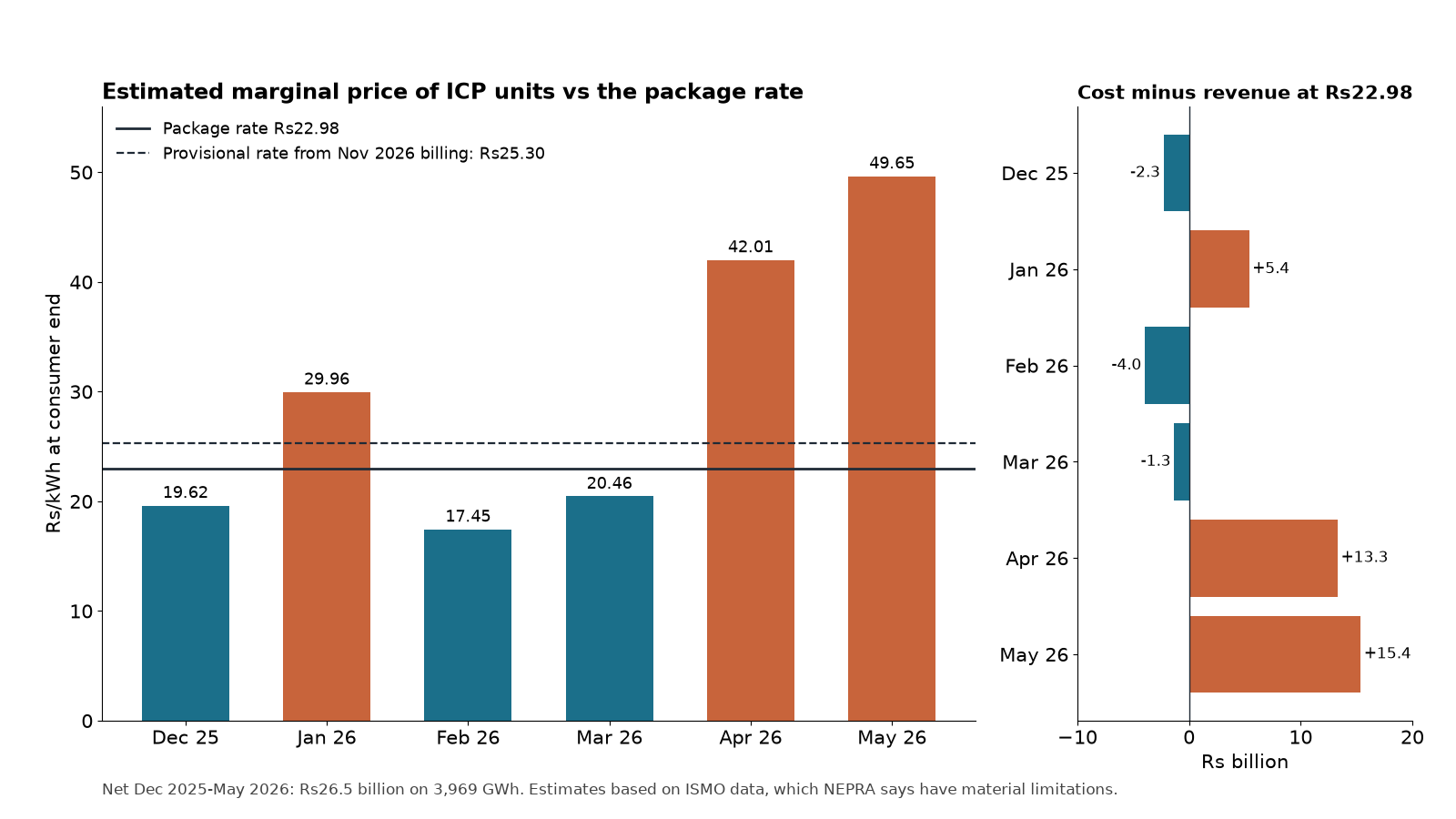
Over the six months, 3,969 GWh qualified for the package: 3,420 GWh in the ex-WAPDA companies and 549 GWh at K-Electric. The estimated marginal cost of serving those units comes to Rs117,659 million. That is a notional Rs25.68/kWh at generation level and Rs29.65/kWh at the consumer end, Rs6.67 above the package rate.
The monthly path is uneven. Consumer-end estimates were below Rs22.98 in December, February and March, at Rs19.62, Rs17.45 and Rs20.46. January reached Rs29.96. April and May were far higher, at Rs42.01 and Rs49.65.
Our calculation of the gap
Multiplying each month's units by Rs22.98 and subtracting the result from NEPRA's estimated cost gives the implied under or over-recovery. By our calculation:
- December 2025: about Rs2.3 billion over-recovered
- January 2026: about Rs5.4 billion under-recovered
- February and March: about Rs4.0 billion and Rs1.3 billion over-recovered
- April and May: about Rs13.3 billion and Rs15.4 billion under-recovered
The net figure for the six months is about Rs26.5 billion. April and May alone account for Rs28.7 billion of shortfall, more than the net total, because the three cheaper months offset about Rs7.6 billion. Even at the new Rs25.30 rate, the same units and costs would have left a gap of about Rs17.3 billion.
These are our calculations on NEPRA's published estimates, and they inherit every limitation the regulator attaches to them. The decision says the hourly data initially lacked operational tags under the market commercial code, that results differ from fuel charge workings, that later RLNG price adjustments are not included, and that a PLEXOS run with and without ICP demand is still needed. The dissenting members record that NEPRA's first estimate was about Rs31.83/kWh and fell to Rs29.65 once ISMO supplied operational and must-run tags, with four further adjustments outstanding that would likely reduce it again.
The direction of travel is still informative. Every adjustment discussed in the decision is expected to lower the estimate, yet the estimate starts Rs6.67 above the package rate. It would take a large correction to close that gap entirely.
Who carried the cost
Under the original design, the difference has already been paid. NEPRA's majority states plainly that, because the review was delayed, the delta has been borne by all consumers through fuel charge adjustments. The dissent adds a second channel: incremental units are excluded from quarterly tariff adjustments, so their exclusion raises the quarterly adjustment carried by consumers outside the package.
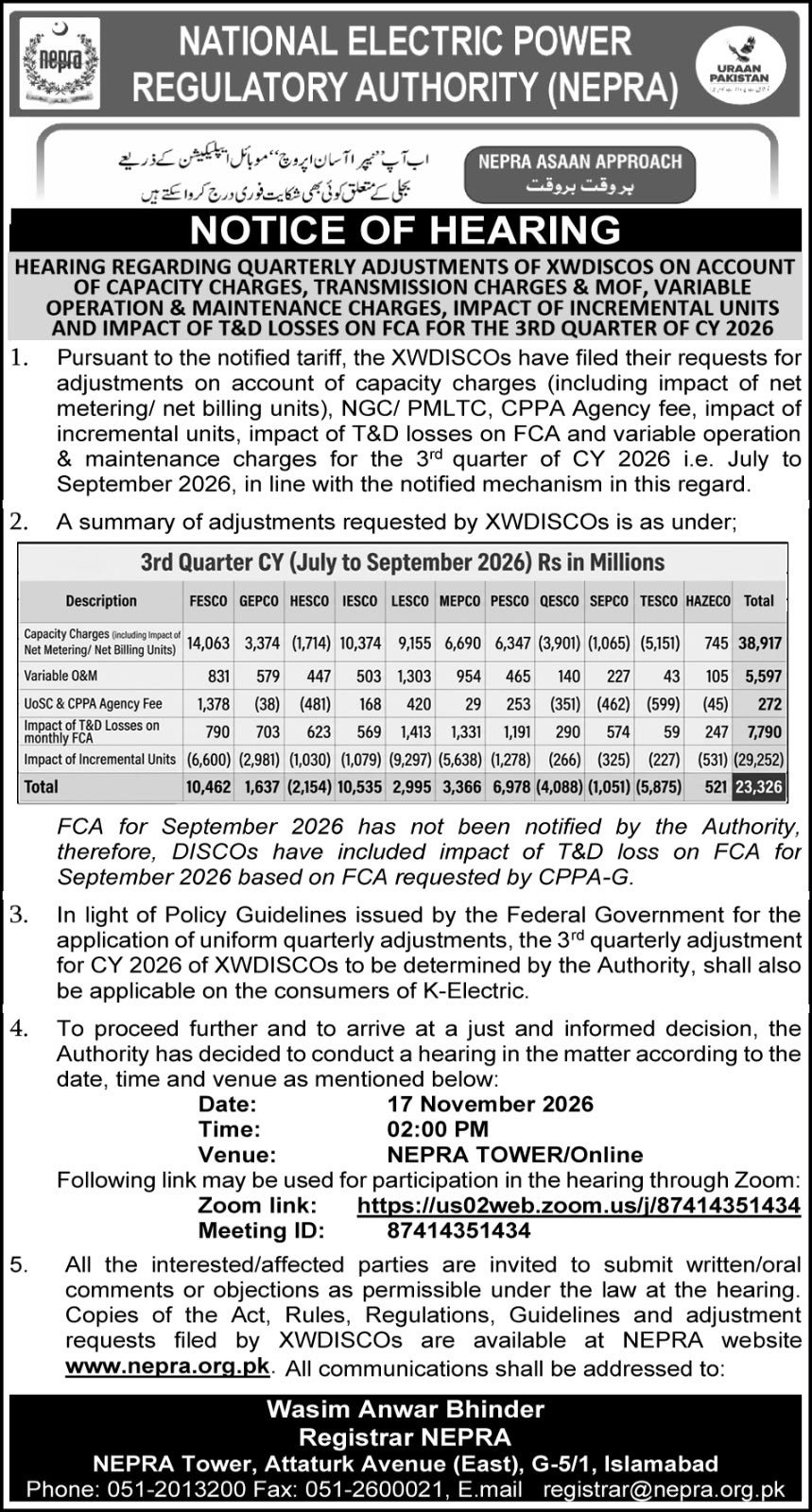
The distribution companies' pending third-quarter request, due for hearing on 17 November, carries a separate line for the impact of incremental units: negative Rs29,252 million, set against Rs52,576 million of other cost items, for a net claim of Rs23,326 million. The hearing notice does not show how that line is derived, so the hearing is a natural place to test how much of the package's cost has moved through quarterly adjustments.
The ministry's case for the package rests on a wider view of costs. It told NEPRA that falling grid sales leave fixed costs under-recovered, citing an annual contribution margin impact of about Rs180 billion from declining load, and that the package's effect on the overall consumer tariff from January to August 2026 was limited to about Rs0.65/kWh, or roughly 1.95%. Some stakeholders argued that much of the qualifying demand reflected migration from captive generation prompted by the gas levy, and others, including the Korangi Association of Trade and Industry, asked for any revision to apply from June. NEPRA said captive-to-grid migration still serves the package's aim of raising grid sales, and asked the ministry to devise a way to identify furnace-oil captive users who may have qualified.
Why the vote split
The majority, comprising the Chairman and the Member (Law), accepted Rs25.30 as an interim measure because it was the only rate proposed by the package's sponsor. It applied the rate from November to avoid reopening October bills and kept the package running. The Chairman's additional note gives the ministry one more chance to supply the data and warns of suspension or termination after the second review if it does not.
The Member (Tariff and Finance) and the Member (Development) dissented. They called Rs25.30 unconnected to actual marginal cost and noted that Rs29.65 would exceed the off-peak rate under the normal tariff, which would defeat the package's purpose. Their preferred course, which they say the case officer also recommended, was a temporary suspension with notice.
What comes next
The ministry must file data and analysis for December 2025 to 15 November 2026 by 25 November, with the rest of November due by 3 December, separated into the first and second review periods and backed by PLEXOS runs. NEPRA has said each period will be assessed separately for the two-consecutive-reviews termination clause.
On the numbers already published, the first review period looks likely to show cost above the original rate. Whether the second period does the same will depend heavily on RLNG availability and spot prices this winter, which the ministry itself cites as the main change in the cost environment.